
TL;DR:
- Your credit score significantly impacts home loan rates, deposit requirements, and lender choices in New Zealand.
- Regular credit monitoring helps detect errors, prevent fraud, and improve approval chances for mortgages.
- Understanding and managing your credit file early can lead to better loan terms and successful homeownership.
Your credit score is quietly shaping your home loan options right now, whether you know it or not. Many first home buyers in New Zealand are surprised to learn that a difference of 50 to 100 points on their credit score can mean thousands of dollars more in interest over the life of a mortgage. Higher scores save thousands on mortgage rates, and monitoring your credit prevents nasty surprises at the worst possible moment. This guide walks you through how credit scores affect your home loan in New Zealand, what the credit bureaus are tracking, and exactly what you can do to stay ahead of the game.
Table of Contents
- How credit scores influence your home loan in New Zealand
- What New Zealand credit bureaus know about you
- Top reasons to regularly monitor your credit in NZ
- When and how to check your credit in New Zealand
- Why credit monitoring is the overlooked weapon for NZ home buyers
- Connect with NZ mortgage advisers for personalised credit support
- Frequently asked questions
Key Takeaways
| Point | Details |
|---|---|
| Better loan terms | Monitoring your credit gives access to lower rates and deposit requirements from lenders. |
| Early error detection | Annual checks help you spot and fix mistakes before they impact your home loan approval. |
| Fraud protection | Regular review guards against identity theft and unauthorised activity in your credit file. |
| Empower decision-making | Being credit-aware means you can negotiate confidently or choose lenders who support your situation. |
| Eligibility for government schemes | Credit monitoring makes it easier to benefit from NZ’s first home buyer programmes despite past issues. |
How credit scores influence your home loan in New Zealand
Your credit score is not just a number. It is a signal that lenders use to decide how much risk they are taking on when they approve your mortgage. In New Zealand, that signal carries real weight when it comes to your interest rate, the size of your required deposit, and which lenders will even consider your application.
According to Centrix data from November 2025, the average credit score for new mortgage applications sits at approximately 749, and 83% of home loan approvals for properties valued at $600,000 or more require a score above 700. That is a clear benchmark. If your score falls below that threshold, you are already working against the odds.
Here is how your score typically affects your loan options:
- Score above 750: You are in a strong position. Major banks will compete for your business, offering their sharpest interest rates and lower deposit requirements.
- Score between 600 and 750: You may still qualify with a mainstream lender, but expect less flexibility on rates and conditions.
- Score below 600: As credit rating research shows, a low score means higher rates, larger deposit requirements, and greater reliance on mortgage brokers or non-bank lenders to find a willing lender.
The difference between a 6.5% and a 7.2% interest rate on a $600,000 mortgage over 30 years is not trivial. It can add up to well over $80,000 in extra repayments. Understanding how credit score and home loan terms are connected is the first step toward protecting yourself from that kind of unnecessary cost.
| Credit score range | Likely lender type | Deposit requirement | Rate impact |
|---|---|---|---|
| 750 and above | Major banks | As low as 10% (with conditions) | Best available rates |
| 650 to 749 | Banks and some non-banks | 10% to 20% | Moderate rates |
| 500 to 649 | Non-bank lenders | 20% or more | Higher rates |
| Below 500 | Specialist lenders only | 30%+ | Significantly higher rates |
If your score is not where you want it to be, the good news is that fixing credit before buying is absolutely achievable with the right approach and enough lead time.
What New Zealand credit bureaus know about you
Now that you understand how credit scores shape your loan options, it is worth knowing exactly what information the credit bureaus are collecting and how they arrive at your score.

New Zealand has three main credit bureaus: Centrix, Equifax, and Illion. Each has a slightly different focus. Centrix tracks local and utility payments, Equifax focuses heavily on bank and mortgage data, and Illion covers a broad range of credit activity. All three offer a free annual credit report, and paid monitoring services are available if you want real-time alerts.
Here is what each bureau records about you:
- Payment history: Whether you pay your bills and loans on time. This is the single biggest factor in your score.
- Credit utilisation: How much of your available credit you are using at any given time.
- Credit inquiries: Every time a lender checks your credit file, it leaves a mark. Too many inquiries in a short period can lower your score.
- Defaults and judgements: Missed payments that have been formally recorded. These are serious and defaults stay on file for up to five years.
- Length of credit history: How long your accounts have been open and active.
Understanding your NZ credit score guide is genuinely empowering. Many Kiwis are surprised to find errors or outdated information on their file that is quietly dragging their score down. A default that was settled years ago, a credit inquiry you did not authorise, or an account that was never properly closed can all leave a mark.
The important thing to remember is that your credit file is a living document. Every responsible financial decision you make today is being recorded. Paying your rent on time, keeping your credit card balance low, and avoiding unnecessary loan applications all contribute positively to the picture the bureaus are building about you.
Top reasons to regularly monitor your credit in NZ
With a clearer picture of what is being tracked, the case for regular credit monitoring becomes very compelling. Think of it as a financial health check, one that costs you nothing but a little time and can save you a great deal of money and stress.
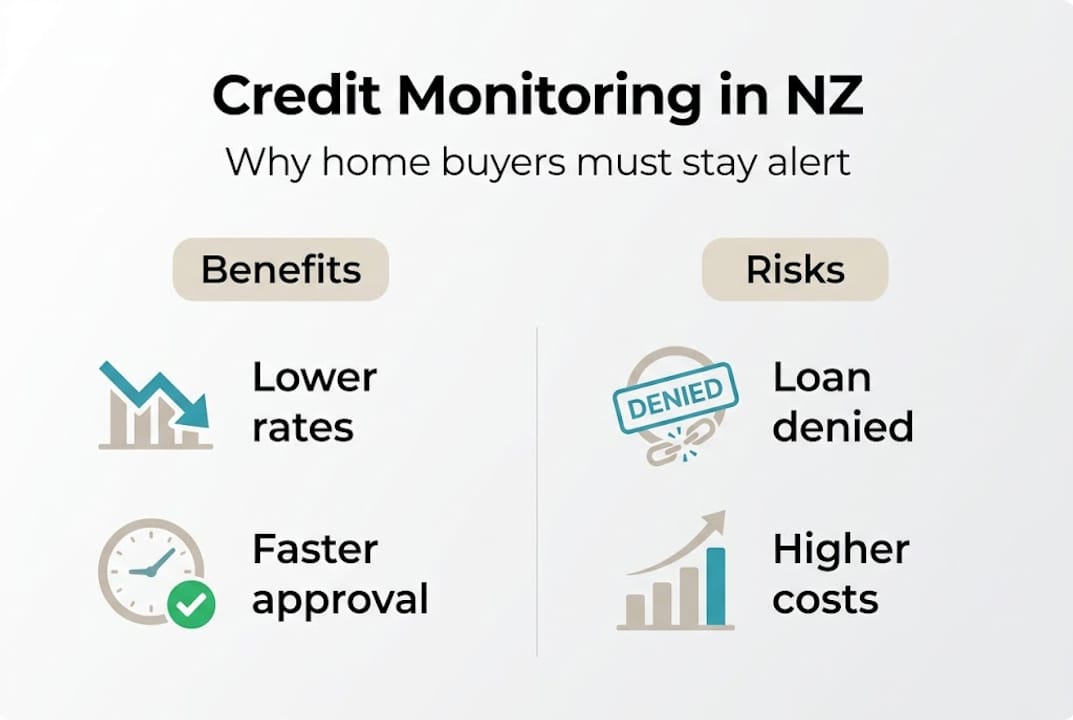
Monitoring your credit is essential for buyers and owners who want to secure favourable loan terms, detect errors or fraud early, and improve their approval chances. Here are the key reasons to make it a habit:
- Catch errors before they cost you: Mistakes on credit files are more common than most people realise. An incorrect default or a misrecorded payment can unfairly lower your score and cost you a better rate.
- Detect identity theft early: Fraudsters sometimes open accounts in other people’s names. Regular monitoring means you will spot unfamiliar credit inquiries or new accounts before the damage becomes serious.
- Know where you stand before applying: Walking into a lender conversation without knowing your credit score is like sitting an exam without studying. Monitoring gives you the knowledge to prepare.
- Track your improvement over time: If you are actively working to build your score, monitoring lets you see the results of your efforts and stay motivated.
Understanding how credit checks work for NZ buyers can also help you avoid the common mistake of applying to multiple lenders at once, which triggers multiple inquiries and can actually lower your score.
“Your credit file is one of the most powerful financial documents you own. Treat it with the same care you would give your KiwiSaver or your savings account.”
Pro Tip: Before you start house hunting seriously, pull your credit report from all three bureaus. Comparing them side by side can reveal discrepancies that a single report would miss. Understanding the credit impact for first home buyers early in the process gives you far more room to act.
When and how to check your credit in New Zealand
Knowing you should monitor your credit is one thing. Knowing exactly when and how to do it is where the real value lies.
Here is a practical, step-by-step approach:
- Request your free annual report: You are entitled to one free report per year from each of the three bureaus. Start with Centrix and Equifax, as these are the most commonly used by mortgage lenders.
- Review every line carefully: Look for accounts you do not recognise, defaults that seem incorrect, and inquiries you did not authorise. Even small errors are worth disputing.
- Dispute errors promptly: If you find a mistake, contact the bureau directly and provide supporting documentation. Both Equifax and Centrix have formal dispute processes, and they are legally required to investigate. Check before applying for loans and correct any errors well in advance.
- Set a calendar reminder: Annual checks are the minimum. If you are planning to buy within the next 12 to 18 months, consider checking every six months.
- Consider paid monitoring: Both Equifax and Centrix offer ongoing credit monitoring services that alert you to changes on your file between annual reviews. This is particularly useful if you are actively working on improving your credit score or have previously been a victim of fraud.
Pro Tip: Time your credit check about six to twelve months before you plan to apply for a home loan. This gives you enough runway to dispute errors and make meaningful improvements before a lender sees your file. If you are also working on rebuilding credit for a mortgage, this lead time is even more important.
The timing of your credit review can be just as important as the review itself. Applying for a home loan with a score that is trending upward is a very different conversation from applying with one that has just taken a hit from a cluster of inquiries.
Why credit monitoring is the overlooked weapon for NZ home buyers
Most Kiwis think of credit monitoring as something you do after something goes wrong. A missed payment, a fraud alert, a declined application. But that reactive mindset is exactly what costs buyers money and opportunity.
We see it regularly at Mortgage Managers. Buyers come to us weeks before they want to settle on a property, only to discover a default they did not know about or a score that is 80 points lower than they expected. At that stage, there is very little room to move.
The buyers who get the best outcomes are the ones who treat their credit file like a strategic asset. They check it early, fix what needs fixing, and walk into lender conversations with confidence. That confidence is not arrogance. It is preparation.
It is also worth knowing that past financial mistakes do not have to define your future. Government schemes like the Kainga Ora First Home Loan are specifically designed to support buyers who may not have a perfect credit history. Monitoring your credit helps you understand whether you qualify and what steps to take to get there. Understanding why credit history matters is not just defensive thinking. It is one of the smartest proactive moves a first home buyer can make.
Connect with NZ mortgage advisers for personalised credit support
Taking control of your credit is one of the most empowering things you can do on the path to homeownership. But you do not have to navigate it alone.

At Mortgage Managers, our team of Auckland mortgage brokers works with first home buyers and current homeowners every day, helping them understand their credit position and what it means for their loan options. We know what lenders are looking for, and we can help you put your best foot forward. Whether you are just starting to think about buying or you are ready to apply, our mortgage advisers can guide you through every step. Reach out to the team at Mortgage Managers today and let us help you turn your credit knowledge into real results.
Frequently asked questions
How often should I check my credit report in New Zealand?
You should check your credit report at least once a year and always before applying for a home loan. Annual checks or before loans are the standard recommendation, with paid monitoring available for more frequent updates.
Does a low credit score mean I can’t get a home loan?
Not necessarily. A low score may limit your options and increase your costs, but low scores mean higher rates rather than an automatic decline, and government schemes like Kainga Ora can support buyers with less-than-perfect credit histories.
What are the main factors affecting my credit score in New Zealand?
Payment history, credit utilisation, length of credit history, defaults, and recent inquiries all directly shape your score. Scores are calculated using a combination of these factors, with payment history carrying the most weight.
How do I fix errors in my credit report?
Contact Equifax or Centrix directly, provide supporting documentation, and follow their formal dispute process. Check before applying and correct errors well in advance of any loan application for the best outcome.
Can monitoring my credit improve my chances for a better mortgage?
Yes, absolutely. Staying on top of your credit file means you can fix errors early and arrive at lender conversations fully prepared. Monitoring improves approval chances and gives you the best shot at securing favourable loan terms.