
Buying your first home in New Zealand can feel like standing at the base of a very steep hill, staring up and wondering if you’ll ever reach the top. The deposit feels impossible, the loan jargon is confusing, and the eligibility rules seem to shift every time you look. But here’s the truth: thousands of Kiwis successfully buy their first home every year, and with the right preparation, you can too. This guide walks you through every key stage, from checking your eligibility and building your deposit, to understanding your loan options and avoiding costly mistakes. Let’s make this feel manageable.
Table of Contents
- Check if you’re eligible to buy your first home
- Save for your deposit and use KiwiSaver smartly
- Understand your home loan options and what you’ll pay
- Navigate the loan application process without stress
- Avoid common mistakes: What first home buyers wish they’d known
- Why most first home buyer advice in NZ misses the mark
- Get expert guidance for your first home journey
- Frequently asked questions
Key Takeaways
| Point | Details |
|---|---|
| Eligibility first | Check you meet all citizenship, income, and deposit criteria before anything else. |
| Use KiwiSaver wisely | Maximise your deposit by using KiwiSaver after three years’ membership for most of your savings. |
| Aim for lower LVR | A higher deposit reduces loan fees and interest, making repayments much easier. |
| Shop around for loans | Comparing lenders saves you money and gets you the best home loan deal. |
| Expert help matters | A good mortgage adviser can simplify the complex process and uncover more options. |
Check if you’re eligible to buy your first home
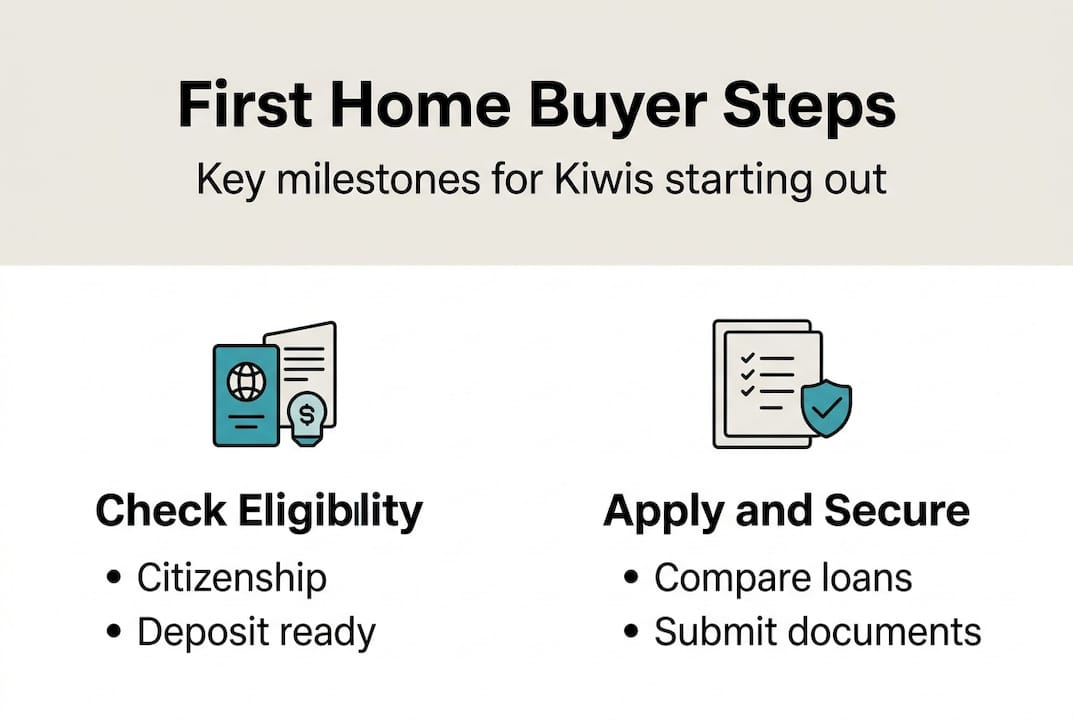
Now that we’ve set the stage, the first step is to confirm if you qualify as a first home buyer. Not everyone realises there are specific criteria you must meet before applying, and skipping this step can waste valuable time.
To be eligible for a Kainga Ora loan eligibility supported home loan, you generally need to be a New Zealand citizen or permanent resident. You must also be a first-time buyer, or a “second-chance” buyer who has previously owned a home but no longer does and meets certain asset thresholds.
Income limits are a key factor. As of 2026, the caps are:
| Buyer type | Income cap (before tax) |
|---|---|
| Single buyer | $95,000 per year |
| Two or more buyers | $150,000 combined |
Beyond income, you’ll need to meet these requirements:
- A minimum 5% genuine deposit, which can come from deposit requirements NZ such as KiwiSaver, personal savings, or gifted funds from family
- The property must be owner-occupied, meaning you intend to live in it, not rent it out
- The property must fall within regional house price caps set by Kainga Ora
Meeting all of these criteria is essential before you even approach a lender. Think of eligibility as the foundation of your home buying journey. If one piece is missing, the whole structure becomes unstable. Take the time to confirm every box is ticked, because doing so early saves you from disappointment later.
Save for your deposit and use KiwiSaver smartly
Once you know you’re eligible, the next step is building your deposit with every tool available. The minimum is 5%, but aiming for 10% to 20% will significantly improve your loan options and reduce what you pay over time.
KiwiSaver is one of the most powerful tools available to first home buyers. Here’s how to use it effectively:
- Confirm you’ve been a KiwiSaver member for at least 3 years
- Check your current balance, including employer contributions and any government contributions
- Apply to withdraw your savings through your KiwiSaver provider, noting that KiwiSaver withdrawal rules require you to leave a minimum of $1,000 in your account
- Factor in the timing, as withdrawals can take several weeks to process
You can find detailed KiwiSaver withdrawal steps on the Mortgage Managers website, along with guidance on managing KiwiSaver to maximise your balance before you buy.
Other deposit sources worth considering include personal savings, a gift from family members (which must be documented), and in some cases a combination of all three. There are also ways to save for your deposit that many first home buyers overlook, such as reducing discretionary spending and setting up dedicated savings accounts.
One important update: the First Home Grant ended in May 2024 and is no longer available. If you’ve read older guides that mention it, please disregard that information.
“The earlier you start documenting your deposit sources, the smoother your loan application will be. Lenders want a clear paper trail.”
Pro Tip: Start gathering proof of your deposit at least three months before you plan to apply. Bank statements, KiwiSaver balance certificates, and any gift letters should all be ready to go.
Understand your home loan options and what you’ll pay
With your deposit strategy sorted, it’s time to make sense of the loans and fees involved. The size of your deposit directly shapes which loans you can access and how much you’ll pay each month.

Here’s a quick comparison of how deposit size affects your options:
| Deposit size | LVR | Loan type available | Low-equity fee? |
|---|---|---|---|
| 5% | 95% | Kainga Ora backed | Yes |
| 10% | 90% | Some standard banks | Possibly |
| 20% or more | 80% or less | All standard banks | No |
LVR stands for loan-to-value ratio. It’s simply the percentage of the property’s value that you’re borrowing. A higher LVR means more risk for the lender, which is why they charge low-equity fees or premiums to offset that risk. LVR changes announced by the Reserve Bank of New Zealand came into effect in late 2025, easing some restrictions and giving buyers with smaller deposits slightly more flexibility in 2026.
Key points to understand:
- Kainga Ora backed loans are offered through participating banks and allow a 5% deposit, but come with eligibility requirements
- Standard bank loans typically require 10% to 20% and offer more competitive rates for those with larger deposits
- Low-equity fees can add thousands of dollars to your loan over time, so lower mortgage repayments are achievable by aiming for a higher deposit
- KiwiSaver home loans can be combined with standard lending to boost your deposit
Pro Tip: If you’re buying a new build, some lenders allow a 10% deposit without the same low-equity fees that apply to existing properties. Always ask your adviser about new build incentives.
Navigate the loan application process without stress
After choosing your loan option, you’ll need to navigate the application process confidently. It’s more straightforward than most people expect, especially when you know what to prepare.
Here’s a step-by-step breakdown:
- Get pre-approval first. This tells you how much a lender is willing to lend before you start house hunting, giving you a realistic budget
- Gather your documents. You’ll need proof of income (payslips or tax returns), proof of your deposit source, photo ID, and a summary of your regular expenses
- Meet with a mortgage adviser. They’ll assess your full financial picture and match you with the most suitable lender and product
- Submit your application. Your adviser handles most of this, but be ready to answer follow-up questions from the lender
- Receive formal approval. Once the lender is satisfied, they issue a formal loan offer
One thing many first home buyers don’t realise is that stress testing process means banks assess your ability to repay at interest rates higher than the current rate, often 2% to 3% above what you’d actually pay. This protects you from future rate rises. Banks also apply a debt-to-income (DTI) cap of 6 times your gross income, meaning if you earn $80,000 per year, you can borrow up to $480,000.
If you’re unsure about using KiwiSaver during application, your adviser can walk you through the timing and documentation required.
“Be completely honest with your adviser about your finances. The more they know, the better they can advocate for you with lenders.”
Pro Tip: Don’t apply to multiple banks simultaneously. Each application leaves a credit enquiry on your file, which can lower your credit score and raise red flags for lenders.
Avoid common mistakes: What first home buyers wish they’d known
Before you finalise your buying decision, learn from those who’ve gone before you and sidestep needless headaches. The most costly mistakes are almost always avoidable.
Here are the ones we see most often:
- Not budgeting for low-equity fees. Many buyers focus only on the purchase price and forget that a low deposit triggers additional costs that inflate monthly repayments
- Missing deposit documentation. Gifted funds from family must be accompanied by a signed gift letter confirming the money doesn’t need to be repaid. Without this, lenders won’t count it
- Overstretching with a high LVR loan. A higher LVR means more interest paid over the life of the loan. Borrowing at 95% when you could wait and save to 80% can cost tens of thousands of dollars extra
- Assuming all lenders are the same. Lender policies vary significantly. One bank might decline your application while another approves it with a competitive rate
- Skipping professional advice. First home buyers who go it alone often miss products and structures that could save them money
“Shopping around isn’t just about finding the lowest rate. It’s about finding the lender whose criteria best match your situation.”
Pro Tip: Before you apply anywhere, ask your mortgage adviser to review each lender’s assessment criteria. Some banks are more flexible on certain income types or deposit sources, and knowing this upfront can save weeks of back-and-forth.
For more tailored guidance, the first home buyer KiwiSaver tips on the Mortgage Managers website are well worth reading before your application.
Why most first home buyer advice in NZ misses the mark
Here’s something most official guides won’t tell you: the standard checklists and government eligibility pages are useful, but they only get you so far. They tell you the rules. They rarely tell you how to work within them strategically.
The biggest gap in conventional first home buyer advice is the assumption that all lenders behave the same way. They don’t. Lender policies differ on everything from how they assess self-employed income to how they treat gifted deposits and KiwiSaver balances. A good mortgage adviser who understands the role of mortgage adviser isn’t just filling out paperwork. They’re matching your specific circumstances to the lender most likely to say yes, at the best possible terms.
We’ve seen buyers who were told by one bank they didn’t qualify, only to be approved by another within the same week. That’s not luck. That’s strategy.
The other overlooked advantage is flexibility on deposit sources. Creative approaches, such as combining KiwiSaver with a family gift and a small personal savings top-up, can get you to a 10% deposit faster than you think. Advisers who know the landscape can often find paths that buyers searching alone simply wouldn’t see. Treat your adviser as a strategic partner, not a gatekeeper.
Get expert guidance for your first home journey
If you’re ready to move forward confidently, the next best move is getting experienced help on your side.

At Mortgage Managers, we work with first home buyers across Auckland, the North Shore, West Auckland, and remotely throughout New Zealand. Our team helps you cut through the confusion, compare lenders, and structure your application for the best possible outcome. Whether you’re just starting to save or ready to apply for your first home loan right now, we’re here to help. You can talk to mortgage brokers who genuinely understand the NZ market, or learn more about how advisers in home buying make the process smoother and smarter. No obligation, just honest guidance.
Frequently asked questions
What deposit do I need for my first home in New Zealand?
You need a minimum 5% deposit to access a Kainga Ora backed loan, but saving 10% to 20% will open more lender options and help you avoid low-equity fees that add to your repayments.
Can I use KiwiSaver for my first home deposit?
Yes, after at least 3 years of membership you can withdraw KiwiSaver savings including employer and government contributions, as long as you leave a minimum of $1,000 in your account.
Is the First Home Grant still available in New Zealand?
No, the First Home Grant ended in May 2024 and is no longer an option for buyers. Make sure any guide you’re reading reflects this update.
What is an LVR, and why does it matter?
LVR is your loan-to-value ratio, and a higher LVR means more interest and fees over the life of your loan, so a larger deposit directly reduces what you pay overall.