
You’ve saved your deposit, sorted your income, and you’re ready to buy your first home. But here’s what most Kiwi buyers don’t realise: even with a solid deposit and steady earnings, poor credit history can block your mortgage approval or limit your options. Home loan decline rates sit under 5-10%, yet credit issues remain a top reason for rejections. This article will demystify what makes up your credit history, why lenders scrutinise it so closely, and the practical steps you can take to strengthen your position before applying.
Table of Contents
- What is credit history and how is it calculated in New Zealand?
- How your credit history affects home loan approval
- Why credit history matters more than most buyers expect
- How to check, fix and boost your credit history before applying
- Get expert help navigating home loans and credit
- Frequently asked questions
Key Takeaways
| Point | Details |
|---|---|
| Credit history is crucial | Your credit history can decide whether you get a home loan and what your interest rate will be. |
| Good scores open options | A score of 650 or higher gives you access to more banks and better home loan deals. |
| Problems can be fixed | You can check, correct, and improve your credit history before applying for a mortgage. |
| Help is available | Mortgage advisers and brokers can guide you through tricky credit problems and wider lender choices. |
What is credit history and how is it calculated in New Zealand?
Now that you know a declined loan isn’t always about saving enough, let’s uncover what ‘credit history’ really means and how banks see it.
Your credit history is your financial track record. It shows how you’ve managed debt over time, including loans, credit cards, hire purchases, utility bills, and even mobile phone contracts. Every repayment, missed payment, default, or court judgment gets recorded by credit bureaus like Centrix, Equifax, and illion. Lenders review this history to gauge whether you’re a reliable borrower.
In New Zealand, credit scores range from 0-1000, with Centrix using a 1-1000 scale. Your score is calculated based on several key ingredients: payment history (whether you pay on time), length of credit history, types of credit you hold, amounts owed, recent credit inquiries, and any defaults or judgments against you. Think of it as a financial report card that lenders use to predict your future behaviour.
Here’s how Centrix categorises credit scores:
| Score Range | Category | What It Means |
|---|---|---|
| 819-1000 | Excellent | Top tier borrower, best rates available |
| 768-818 | Very Good | Strong credit profile, competitive rates |
| 651-767 | Good | Acceptable to most lenders |
| 530-650 | Fair | May face higher rates or stricter conditions |
| 0-529 | Poor | Limited options, likely non-bank lenders only |
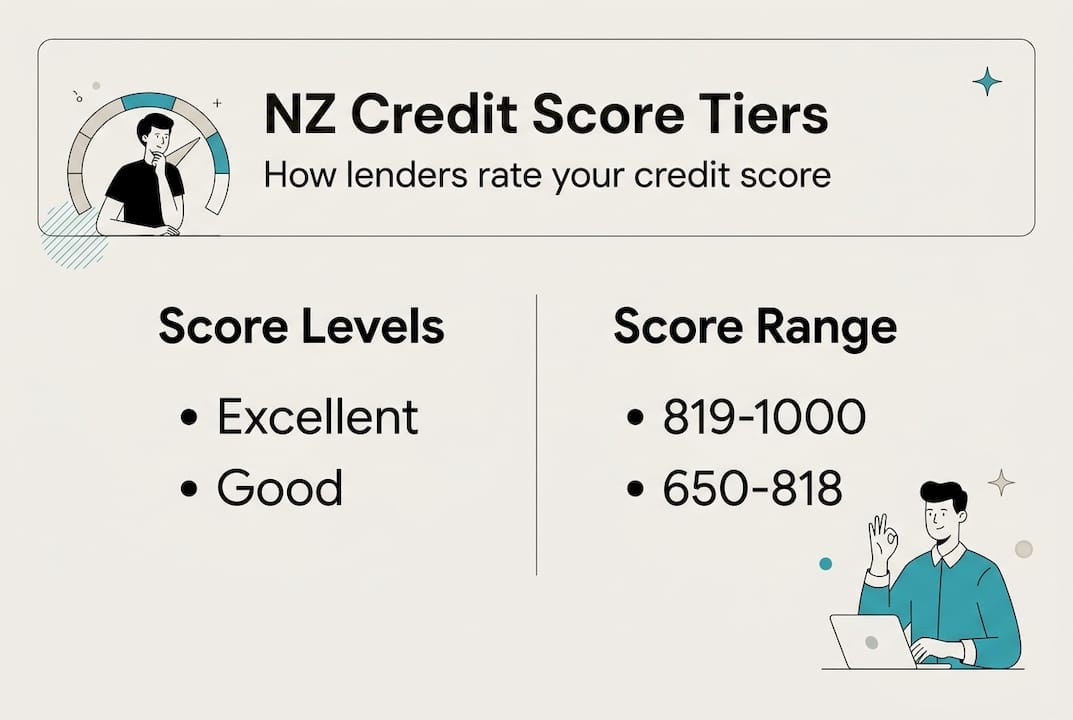
Lenders use rules of thumb when assessing your application. A score of 650 or higher is generally considered ‘good’ and opens doors with most banks. Scores above 819 are excellent and typically secure the best interest rates and terms. Below 650, you may face additional scrutiny, higher rates, or even decline.
Why does this matter so much to mortgage banks and non-bank lenders? Because your credit history helps them assess risk. A borrower with a clean payment record and diverse credit types signals reliability. Someone with defaults, missed payments, or a thin credit file raises red flags. Banks want confidence that you’ll repay hundreds of thousands of dollars over 25 or 30 years.
Understanding how credit scores work gives you power. You can see where you stand and take steps to improve before you apply.
Pro Tip: Your credit score isn’t static. It changes as you pay bills, take on new credit, or clear old debts. Check it regularly to track your progress.
How your credit history affects home loan approval
With those basics covered, let’s see exactly how your history comes into play when you apply for a mortgage.
Lenders don’t rely on credit history alone. They assess multiple pillars: your deposit size, income (including debt-to-income ratios), loan-to-value ratio (LVR), and serviceability (whether you can afford repayments). But credit history acts as a gatekeeper. If it’s weak, the other factors may not matter.
Recent defaults, missed payments, or a short credit history can limit how much you can borrow or push your interest rate higher. Decline rates remain under 5-10% when working with advisers, but credit issues are consistently among the top reasons for rejection. Even if you’re not declined outright, a poor score can mean conditional approval with tougher terms.

Here’s what happens to your application based on credit tier:
| Credit Tier | Likely Outcome | Interest Rate Impact | Borrowing Limit |
|---|---|---|---|
| Excellent (819+) | Fast approval, best terms | Lowest available rates | Full amount requested |
| Good (650-818) | Standard approval | Competitive rates | Full or near-full amount |
| Fair (530-649) | Conditional approval, extra checks | Slightly higher rates | Reduced limit or larger deposit required |
| Poor (<530) | Likely decline from banks | Much higher rates (10-18%) | Non-bank lenders only, strict conditions |
When you submit a mortgage application, here’s the sequence a bank or lender follows:
- Initial credit check: The lender pulls your credit report and score from one or more bureaus.
- Red flag review: They scan for defaults, court judgments, missed payments, or high credit utilisation.
- Income and deposit verification: They confirm your earnings, employment stability, and deposit source.
- Serviceability calculation: They assess whether you can afford repayments based on income, expenses, and debt-to-income rules.
- Conditional approval or decline: If everything aligns, you receive conditional approval. If credit issues surface, they may request explanations, decline, or offer reduced terms.
Minor errors on your credit file are surprisingly common. A payment marked late when it wasn’t, a default that’s been resolved but not updated, or an account that doesn’t belong to you can all drag your score down. Checking your report before applying gives you time to dispute mistakes and clean up your file.
If you’re concerned about your eligibility, learning how to improve home loan eligibility can make a real difference. For those with existing credit challenges, exploring bad credit loan options early helps you understand what’s possible.
Pro Tip: Don’t apply for multiple loans or credit cards in the months before your mortgage application. Each hard inquiry can lower your score slightly, and multiple inquiries signal financial stress to lenders.
Why credit history matters more than most buyers expect
But why does this ‘score’ carry so much weight, and what happens if yours isn’t perfect?
Most banks want a ‘Good’ credit rating or better, roughly 650 or above. If your history is weak or patchy, you may only qualify with non-bank lenders, and rates can jump to 10-18%. That’s a significant difference. On a $500,000 loan, an extra 5% in interest could cost you tens of thousands more each year.
If your credit history isn’t ideal, you’re not out of options. Other approval workarounds include offering a larger deposit (reducing the lender’s risk), bringing in a loan guarantor (someone who agrees to cover repayments if you can’t), or working with a mortgage broker who has access to a wider range of lenders. Brokers often know which lenders are more flexible with credit issues and can present your application in the strongest light.
Only 20% of Kiwis have an ‘Excellent’ credit score. That means most buyers fall somewhere in the middle, and many have room for improvement.
Here are some hidden impacts of a weaker credit history that buyers often overlook:
- More paperwork: Lenders may request additional documentation, explanations for past defaults, or proof that issues have been resolved.
- Slower approvals: Applications with credit concerns take longer to process as lenders conduct extra checks.
- Smaller lending pool: Some banks have strict credit thresholds and won’t consider your application at all, limiting your choices.
- Higher interest rates: Even if approved, you may not qualify for the advertised rates and end up paying more over the life of the loan.
- Stricter conditions: Lenders might require you to maintain a higher deposit, accept a shorter loan term, or agree to regular reviews.
The good news? You don’t have to wait for the bank to notice issues. Running your credit report early gives you time to address problems, dispute errors, and strengthen your position. If you’re navigating bad credit approval tips, understanding your options upfront saves time and stress. For a deeper dive, check out bad credit loan options explained.
Pro Tip: If you’ve had credit issues in the past but have since improved your habits, write a brief explanation for your lender. Showing that you’ve addressed the problem and maintained good behaviour since can help your case.
How to check, fix and boost your credit history before applying
If you’re feeling anxious about your credit or aren’t sure where you stand, here are the steps to take before you apply.
Start by checking your credit file. You can request a free report from Centrix, Equifax, or illion, either online or by post. Checking your credit history is the first step to understanding where you stand. Review it carefully for errors, outdated information, or accounts you don’t recognise.
Here’s a step-by-step process to clean up and improve your credit:
- Order your credit report: Get copies from all three bureaus (Centrix, Equifax, illion) to ensure consistency.
- Dispute errors: If you spot mistakes, contact the bureau immediately with supporting documents to have them corrected.
- Catch up on missed payments: If you’re behind on any bills, bring them current as soon as possible. Payment history is the biggest factor in your score.
- Avoid multiple hard inquiries: Limit new credit applications in the months leading up to your mortgage application. Each hard inquiry can temporarily lower your score.
- Pay down existing debt: Reduce credit card balances and other revolving credit to improve your credit utilisation ratio.
Once you’ve addressed any immediate issues, focus on boosting your score over time:
- Set up direct debits: Automate bill payments to ensure you never miss a due date.
- Pay off credit cards: Aim to keep balances below 30% of your limit, or pay them off entirely.
- Limit new debt: Avoid taking on new loans, hire purchases, or credit cards in the lead-up to your application.
- Stay on top of bills: This includes utilities, phone contracts, and any other regular payments. Even small missed payments can hurt your score.
- Keep old accounts open: Length of credit history matters, so don’t close old credit cards unless necessary.
Timing is crucial. Start these steps at least three months before you plan to apply for a mortgage. Some improvements, like catching up on missed payments, show up quickly. Others, like building a longer credit history, take time. The earlier you start, the better your position when you’re ready to buy.
For tailored guidance, explore resources on rebuilding credit for home loans and credit improvement tips designed specifically for Kiwi first home buyers.
Get expert help navigating home loans and credit
If you want straightforward guidance or want to understand your next move, here’s how advisers can help.
Mortgage advisers understand lender criteria inside and out. They know which banks are more flexible with credit issues, which non-bank lenders offer competitive rates, and how to present your application in the strongest possible light, even if your history isn’t perfect. Working with a broker can be the difference between a decline and an approval.

Brokers can access non-bank or alternative lenders if major banks decline your application. They can also advise on strategies like using a larger deposit, bringing in a guarantor, or timing your application to maximise your chances. Instead of navigating the process alone, you get someone in your corner who’s seen it all before and knows how to get results.
Whether you’re just starting to explore your options or you’re ready to apply, personalised mortgage advice can clarify your next steps. Our team of expert mortgage brokers offers obligation-free consultations to help you understand where you stand and what’s possible. We also provide access to broker-only home loan options that aren’t available directly through banks.
Frequently asked questions
What credit score do I need to buy my first home in New Zealand?
A score of 650 or higher is generally considered ‘good’ and preferred by most lenders, with the best rates given to scores above 819.
Can I get a mortgage in NZ with bad credit?
Yes, but you may need a bigger deposit, a guarantor, or to use a non-bank lender with potentially higher rates between 10-18%.
How do I check my credit report in New Zealand?
You can request a free credit file from Centrix, Equifax, or illion, either online or by post.
How long does bad credit stay on my record in NZ?
Most defaults and collection notices stay on your file for five years, but their impact lessens as your history improves.