
TL;DR:
- A single credit score does not fully represent your creditworthiness; multiple factors influence loan approval.
- Lenders review detailed credit file elements like payment history and unused credit limits, impacting borrowing capacity.
- Checking all major credit bureaus and proactively managing credit habits can improve chances of a first home loan.
Many New Zealanders heading into their first home loan application believe one thing above all else: that a single credit score tells the whole story. It doesn’t. Your credit file is far more layered than a single number, and lenders look at a much richer picture than most buyers realise. A missed payment two years ago might matter less than an unused credit card with a $10,000 limit sitting in your wallet right now. This guide breaks down exactly what your credit file contains, how lenders in New Zealand use it, and what practical steps you can take to put your best foot forward when applying for a home loan.
Table of Contents
- What is a credit file and why it matters for home loans
- Key credit file components influencing your home loan
- How lenders use your credit file in New Zealand
- What first home buyers can do to strengthen their credit file
- Most credit file advice misses these truths for first home buyers
- Get expert help with your credit and home loan
- Frequently asked questions
Key Takeaways
| Point | Details |
|---|---|
| No single NZ credit score | Home loan lenders check multiple credit agencies so your score may differ between reports. |
| Credit file details are critical | Beyond your score, payment history, credit limits, utilities and BNPL all shape your borrowing power. |
| Full credit limits count | Unused credit card limits reduce the amount you can borrow for your home loan in New Zealand. |
| Brokers help with poor files | Mortgage brokers can navigate lender differences and find options even if your credit file isn’t perfect. |
What is a credit file and why it matters for home loans
Your credit file is essentially your financial report card. It’s a detailed record compiled by credit reporting agencies, and it tells lenders a story about how you’ve managed money over time. Understanding what’s inside it is one of the most empowering things you can do as a first home buyer.
A credit file typically contains:
- Payment history: Whether you’ve paid bills, loans, and credit cards on time
- Credit limits and balances: How much credit you have access to and how much you’re using
- Account types: Personal loans, credit cards, store cards, and overdrafts
- Recent credit enquiries: Every time you’ve applied for credit in the past few years
- Utilities and Buy Now, Pay Later (BNPL): These are increasingly included and can affect your file
One of the biggest surprises for many buyers is that there is no single NZ credit score. Each credit reporting agency, such as Equifax, Centrix, and illion, holds its own data and calculates its own score. The information can differ between agencies, meaning a lender checking one bureau may see something different from a lender checking another. As noted in our credit assessment for NZ first home buyers, lenders check all bureaus, not just one.
The NZ credit rating impact on home loan outcomes is significant. Payment history, credit utilisation, length of history, types of credit, and recent enquiries all feed into how a lender assesses your risk. Utilities and BNPL services like Afterpay or Laybuy are now part of that picture too.
| Credit file element | Why it matters |
|---|---|
| Payment history | Biggest single factor in credit assessment |
| Credit limits (used and unused) | Directly reduces borrowing capacity |
| Credit enquiries | Too many in a short time signals financial stress |
| BNPL and utilities | Increasingly reviewed by NZ lenders |
| Account types | Shows breadth and management of credit |
Pro Tip: Before you apply for a home loan, request your credit file from each of the major NZ credit bureaus separately. Don’t assume one report tells the full story. You can do this for free, and it gives you a chance to spot errors before a lender does. Learn more about credit scores for NZ home buyers to know what you’re looking at.
Key credit file components influencing your home loan
Now that you understand the basics, let’s look more closely at the parts of your credit file that lenders scrutinise most. This is where the real detail lives, and where many first home buyers are caught off guard.
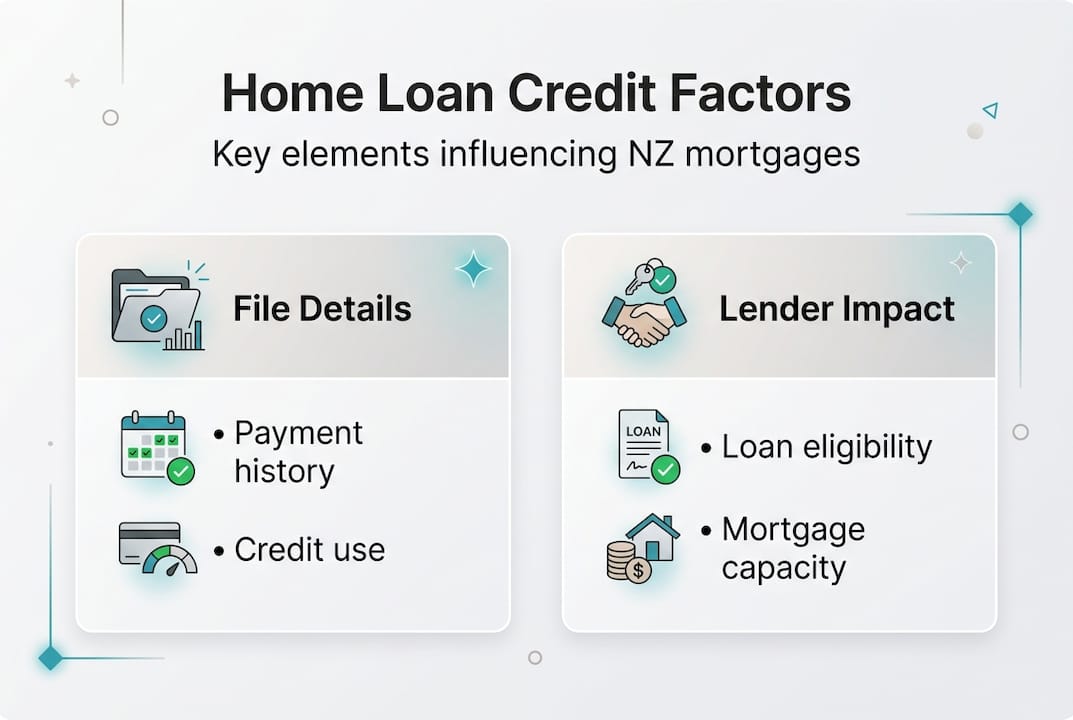
Payment history carries the most weight. Consistent, on-time payments over a long period signal reliability. A single late payment won’t necessarily sink your application, but a pattern of missed payments absolutely will. Lenders want to see that you’re someone who follows through on financial commitments.
Credit utilisation is the ratio of what you owe versus what you have available. High utilisation, say using $8,000 of a $10,000 credit card limit, suggests you may be financially stretched.

Here’s what surprises most buyers: your full credit card limits count against your borrowing power even if unused. Lenders typically apply a multiplier of around five times the total limit when calculating your potential repayment obligations. So a $10,000 credit card limit you never use could still reduce your maximum mortgage by $50,000.
Key credit elements that affect your home loan:
- Payment history: Most influential factor; consistency matters more than perfection
- Unused credit card limits: Counted as potential debt by lenders
- BNPL accounts: Afterpay, Laybuy, and similar services are now visible on credit files
- Number of credit enquiries: Multiple applications in a short window raise red flags
- Length of credit history: Longer, stable histories are viewed more favourably
| Credit factor | Typical lender impact |
|---|---|
| Consistent payment history | Positive; improves loan eligibility |
| High unused credit limits | Negative; reduces borrowing power |
| Multiple recent enquiries | Negative; signals financial instability |
| BNPL accounts | Variable; depends on payment conduct |
As outlined in our credit assessment guide, CC limits reduce mortgage capacity by roughly five times the total limit. Understanding comparing credit scores across agencies helps you see the full picture. Poor credit can lead to higher interest rates, smaller loan approvals, or outright denial, so understanding these levers gives you real power to act. See how credit score impact on loans plays out in real applications, and explore ways to boost home loan approval before you apply.
How lenders use your credit file in New Zealand
Knowing what’s in your credit file is one thing. Understanding how a lender actually uses it is another. Here’s a step-by-step look at what happens once you submit a home loan application.
- Initial credit pull: The lender requests your credit file from one or more NZ credit bureaus. This is recorded as a credit enquiry on your file.
- Risk scoring: The lender applies their own internal scoring model to your file. This isn’t the same as the bureau’s score. Each bank or non-bank lender has its own methodology.
- Serviceability assessment: Your credit file is reviewed alongside your income, expenses, and deposit to calculate how much you can borrow and at what rate.
- Decision and offer: Based on the combined picture, the lender decides whether to approve your loan, at what amount, and on what terms.
Not all lenders interpret credit files the same way. Some are more conservative and will decline applications with any blemishes. Others, particularly non-bank lenders, take a more flexible approach and weigh overall conduct more heavily than individual incidents. This is a critical distinction that many buyers miss.
“There is no single NZ credit score. Each agency holds its own data, and comprehensive positive reporting can genuinely help first home buyers who have thin or newer credit files.”
As noted in credit scores NZ, positive reporting aids applicants with thin files. If you haven’t had much credit history, positive data, such as a consistently paid phone plan or utility account, can actually work in your favour under comprehensive credit reporting rules.
Pro Tip: If your credit file has any blemishes, don’t apply to multiple lenders at once. Each application leaves an enquiry on your file. Instead, work with a mortgage broker who can assess your situation and approach the right lender first time. Review the responsible lending rules that govern how lenders must treat your application, and understand the full credit assessment steps involved.
What first home buyers can do to strengthen their credit file
Knowledge without action won’t get you a home loan. Here are concrete steps you can take right now to strengthen your credit file and improve your chances of approval.
Step 1: Request your credit reports from all major bureaus.
In New Zealand, you can get your credit file free from Equifax, Centrix, and illion. Don’t rely on just one. Check each report carefully for errors, outdated information, or accounts you don’t recognise.
Step 2: Dispute any inaccuracies.
If you find something wrong, contact the bureau directly. Errors on credit files are more common than people think, and they can unfairly drag down your assessment.
Step 3: Improve your payment history from today.
Set up automatic payments for all bills, loans, and credit cards. Even small consistent improvements over six to twelve months can meaningfully shift how lenders view your file.
Step 4: Reduce or close unused credit limits.
If you have credit cards you rarely use, consider reducing their limits or closing them. This directly increases your borrowing capacity by reducing the debt lenders assume you could draw on.
Step 5: Minimise new credit applications.
Every credit enquiry leaves a mark. In the months before applying for a home loan, avoid applying for new credit cards, personal loans, or BNPL accounts.
Additional habits that help:
- Pay all BNPL accounts on time, every time
- Keep credit card balances well below their limits
- Maintain stable employment and banking conduct
- Avoid large unexplained cash withdrawals in the lead-up to your application
If your credit record isn’t perfect, don’t give up. Brokers help poor credit cases get considered by lenders who might otherwise say no. A good mortgage adviser knows which lenders are more flexible and how to present your application in the strongest possible light. Find out how buying a house with bad credit can still work, and explore ways to improve mortgage eligibility before you make your move.
Most credit file advice misses these truths for first home buyers
Here’s something we’ve seen time and again working with first home buyers across Auckland and beyond: most credit file advice focuses on what to avoid rather than what to build. That’s only half the picture.
A perfect credit file is not the goal. Consistency is. Lenders are not looking for a flawless record; they’re looking for evidence that you manage money responsibly over time. One isolated misstep, handled well and followed by solid conduct, rarely derails a well-prepared application.
The credit limit issue is the one that catches people most off guard. Many buyers assume that because they don’t use their credit cards, those limits don’t matter. They do. Significantly. Closing or reducing limits before you apply is one of the highest-impact actions you can take, yet it’s rarely mentioned in generic credit advice.
Another truth: because there is no single NZ credit score, checking only one bureau gives you an incomplete map. We always encourage buyers to check every bureau before applying. You might find a discrepancy that, once corrected, changes your outcome entirely.
Finally, if you have a thin credit file, positive reporting is your friend. Consistent payment of utilities, phone plans, and even BNPL accounts can work in your favour. Understand the bad credit realities so you can approach your application with clear eyes and a realistic plan.
Get expert help with your credit and home loan
Understanding your credit file is a powerful first step, but knowing how to present it to the right lender is where expert guidance becomes a real game-changer.

At Mortgage Managers, we work with first home buyers every day, including those with imperfect credit histories, thin files, or complex financial situations. Our Auckland mortgage brokers know which lenders are more flexible, how to interpret your credit file strategically, and how to advocate on your behalf. Think of us as your personal mortgage advisers, shopping the market to find the loan that fits your real situation. Based in Hobsonville and serving buyers across West Auckland, the North Shore, and all of New Zealand remotely, we’re here to help you move forward with confidence.
Frequently asked questions
How can I check my credit file before applying for a mortgage in NZ?
You can request your credit file free from each major credit reporting bureau in New Zealand, including Equifax, Centrix, and illion, directly through their websites. Because lenders check all bureaus, reviewing each one separately gives you the most complete picture.
Will one late payment ruin my chance at getting a home loan?
No, a single late payment is unlikely to end your home loan application. Lenders value overall payment history and consistency over time, and a mortgage broker can help present isolated blemishes in context.
Why do unused credit card limits matter when applying for a mortgage?
Banks count your full credit card limits as potential debt when calculating borrowing capacity, even if you never use them, which can meaningfully reduce the amount you’re eligible to borrow.
Does it matter which credit agency I check in New Zealand?
Yes, it matters a great deal. Because there is no single NZ score, each agency holds different data, so reviewing all of them ensures you catch discrepancies before a lender does.