
Securing a mortgage as a first home buyer in Auckland can feel overwhelming, especially when facing challenges like limited credit history, high property prices, or a small deposit. Many aspiring homeowners find themselves unsure where to start or how to strengthen their application. The good news is that mortgage eligibility isn’t fixed. By taking strategic steps to improve your credit profile, manage debts, optimise your deposit, and work with expert advisers, you can significantly boost your chances of approval and move closer to owning your first home in Auckland’s competitive market.
Table of Contents
- Key takeaways
- Understanding mortgage eligibility basics in Auckland
- Improving your credit profile to boost mortgage approval chances
- Managing debts and deposit strategies to strengthen your application
- Working with mortgage advisers and securing pre-approval
- Find expert mortgage advisers to improve your eligibility
- Frequently asked questions
Key Takeaways
| Point | Details |
|---|---|
| Kāinga Ora 5% deposit | The Kāinga Ora First Home Loan allows a five per cent deposit with income caps and no house price caps as of 2026. |
| Improve credit profile | Obtain your free credit report, dispute errors, pay on time and reduce credit utilisation below thirty per cent to improve approval odds within weeks. |
| Show genuine savings | Demonstrate genuine savings over several months to strengthen your loan application. |
| Pre approval boost | Work with lenders or mortgage advisers to secure pre approval, increasing your chances of loan success. |
Understanding mortgage eligibility basics in Auckland
Lenders assess several core factors when evaluating your mortgage application. Your deposit size, income stability, employment history, and credit record all play crucial roles in determining whether you’ll be approved and what interest rate you’ll receive. For Auckland first home buyers, understanding these fundamentals helps you identify which areas need attention before applying.
First home buyers in Auckland can access Kāinga Ora First Home Loan requiring only 5% deposit, with income caps and no house price caps as of 2026. This government-backed scheme opens doors for buyers who might otherwise struggle to save a traditional 20% deposit. Income limits apply based on household size, but the scheme removes the previous house price restrictions, making it more accessible across Auckland’s diverse property market.
Most mainstream lenders prefer a 20% deposit because it reduces their risk and eliminates the need for lenders mortgage insurance. However, low deposit mortgage options exist for buyers who can demonstrate strong income, stable employment, and good credit. These loans typically come with slightly higher interest rates to offset the increased lender risk.
Key eligibility factors lenders examine include:
- Stable employment history of at least six months in your current role
- Consistent income that comfortably covers mortgage repayments plus living expenses
- Clean credit history with no recent defaults or missed payments
- Manageable existing debts relative to your income
- Genuine savings demonstrated over several months
Auckland’s high property prices make eligibility more challenging compared to other New Zealand regions. A median house price above $900,000 means even a 10% deposit requires substantial savings. This reality makes government schemes, KiwiSaver withdrawals, and family assistance increasingly important for first home buyers entering the market.
Improving your credit profile to boost mortgage approval chances
Your credit score directly influences both your approval odds and the interest rate you’ll pay. Lenders view strong credit as evidence of financial responsibility and lower risk. If your credit history has blemishes or is limited, taking deliberate steps to improve it can transform your mortgage prospects within a relatively short timeframe.
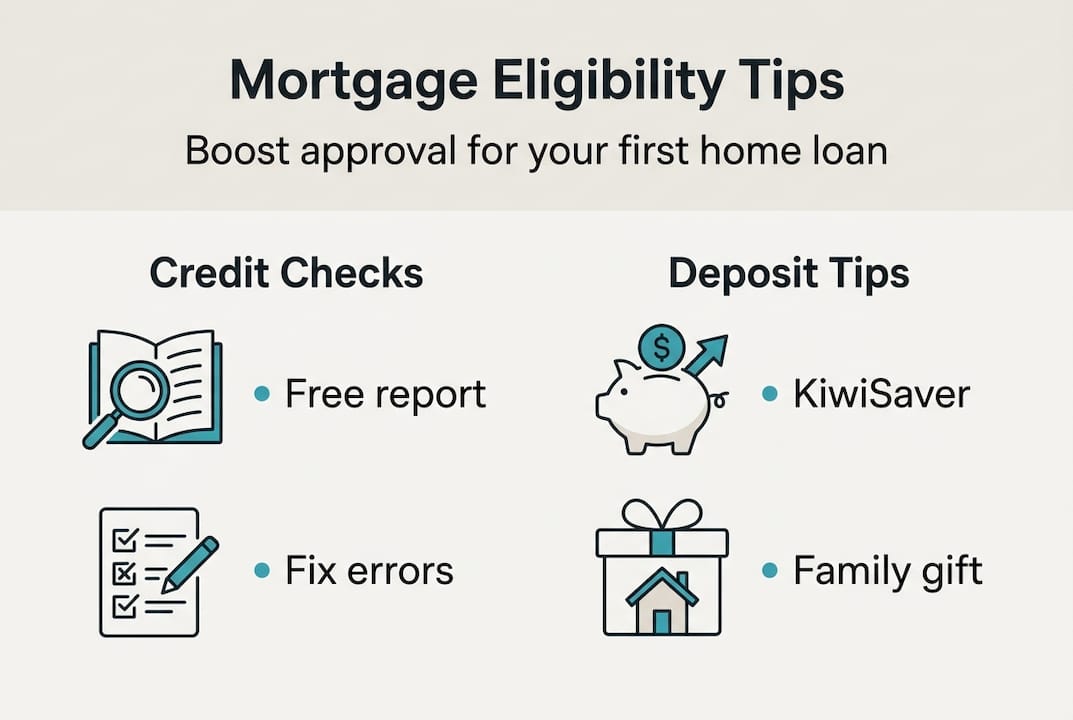
Start by obtaining your free credit report from credit bureaus like Centrix or Equifax. Review every entry carefully for errors or outdated information. Disputing inaccuracies can quickly boost your score if negative marks are removed. Even small improvements in your credit profile can shift you into a better lending category.
Credit repair includes disputing errors, paying bills on time, reducing credit utilisation below 30%, and avoiding new credit applications, with improvements visible in 30-60 days. This timeline means you can make meaningful progress even if you’re planning to buy within the next few months. Consistency matters more than perfection.
Follow these steps to actively strengthen your credit:
- Pay all bills on or before their due dates without exception
- Reduce credit card balances to below 30% of your available limit
- Avoid applying for new credit cards, personal loans, or buy-now-pay-later schemes
- Keep older credit accounts open to maintain a longer credit history
- Set up automatic payments to prevent accidental late payments
- Contact creditors immediately if you anticipate difficulty meeting a payment
Pro Tip: Check your credit score monthly during your improvement phase to track progress and catch new issues early. Many banking apps now offer free credit monitoring as a standard feature.
For buyers with past defaults or court judgements, consider working with specialists who understand how to rebuild credit for mortgage approval. These experts can guide you through rehabilitation strategies and connect you with lenders who assess applications holistically rather than relying solely on credit scores. Patience and consistent positive behaviour will gradually rebuild lender confidence in your financial management.
Even if your credit history is thin rather than damaged, you can build it strategically. Becoming an authorised user on a family member’s well-managed credit card, taking out a small secured loan, or using a credit-builder product can establish positive payment history. The key is demonstrating responsible credit use over time through practical credit improvement tips tailored to New Zealand’s lending environment.
Managing debts and deposit strategies to strengthen your application
Your debt-to-income ratio significantly impacts how much lenders will approve you to borrow. This ratio compares your total annual debt obligations to your gross annual income. Reducing debt-to-income ratio below 6x annual income is crucial for maximising borrowing capacity under current lending restrictions. Lenders use this metric to ensure you can comfortably service mortgage repayments alongside existing commitments.
| Annual income | Maximum total debt (6x ratio) | Impact of $20k personal loan |
|---|---|---|
| $70,000 | $420,000 | Reduces borrowing by $20k |
| $90,000 | $540,000 | Reduces borrowing by $20k |
| $120,000 | $720,000 | Reduces borrowing by $20k |
Paying down high-interest debts like credit cards and personal loans before applying for a mortgage frees up more borrowing capacity. Every dollar of debt you eliminate translates directly into additional mortgage funds you can access. Focus on clearing smaller debts completely rather than spreading payments thinly across multiple accounts.
Your deposit size also plays a pivotal role in mortgage eligibility. Larger deposits reduce lender risk, often resulting in better interest rates and more favourable loan terms. For buyers with challenged credit, aiming for at least 20% deposit can offset concerns about your credit history and open access to mainstream lenders with competitive rates.
Several deposit sources can help Auckland first home buyers reach their target:
- KiwiSaver withdrawals for eligible first home buyers
- Family gifted deposits with proper documentation
- Personal savings accumulated over time
- Government grants like the First Home Grant
- Equity from existing property if upgrading
Using KiwiSaver withdrawal and family gifts can boost deposit size substantially. KiwiSaver members who have contributed for at least three years can withdraw most of their balance, leaving only $1,000 behind. This often represents tens of thousands of dollars that can push you from a 10% to a 15% or 20% deposit, fundamentally changing your loan options.
Family gifted deposits are widely accepted by lenders, but proper documentation is essential. Your family member will need to sign a statutory declaration confirming the money is a genuine gift with no expectation of repayment. This protects both you and the lender by ensuring the gift doesn’t create hidden debt that affects your serviceability.
Pro Tip: Combine multiple deposit strategies simultaneously. Use your KiwiSaver withdrawal as your base, add family gifts to boost it further, and continue saving personally to cover additional costs like legal fees and moving expenses while maintaining an emergency fund.
For buyers unable to reach 20%, low deposit mortgage schemes like Kāinga Ora or Welcome Home Loan provide pathways to homeownership with as little as 5% down. These options typically require strong income and credit but remove the deposit barrier that stops many first home buyers. Understanding which scheme fits your situation can accelerate your timeline significantly.
Working with mortgage advisers and securing pre-approval
Navigating Auckland’s mortgage landscape alone can be daunting, especially for first home buyers facing credit challenges or deposit constraints. Mortgage advisers provide access to multiple lenders including non-bank options for bad credit, and pre-approval shows financial readiness essential in Auckland’s competitive market. These professionals understand which lenders specialise in different scenarios and can match your situation to the most suitable options.
Mortgage advisers bring several advantages to your home-buying journey. They maintain relationships with numerous lenders beyond the major banks, including specialist non-bank lenders who assess applications more flexibly. This access is particularly valuable if you have bad credit, self-employment income, or other factors that mainstream banks view cautiously.
Advisers also handle the complex paperwork and liaise with lenders on your behalf, saving you time and reducing stress. They know exactly what documentation each lender requires and how to present your application in the strongest possible light. For buyers juggling work and house hunting, this support proves invaluable.
Securing mortgage pre-approval before you start seriously house hunting offers significant advantages. Pre-approval involves a lender thoroughly assessing your financial situation and confirming how much they’re willing to lend you. This process typically takes two to four weeks and requires comprehensive documentation.
Follow these steps to obtain pre-approval:
- Gather recent payslips, bank statements, and proof of deposit savings
- Obtain your credit report and address any issues proactively
- Calculate your budget including all ongoing expenses and debts
- Meet with a mortgage adviser to discuss your situation and goals
- Submit your application with all required supporting documents
- Respond promptly to any lender queries or requests for additional information
Pre-approval documentation typically includes:
- Three months of bank statements showing income and spending patterns
- Recent payslips or proof of self-employment income
- Identification documents like passport and driver licence
- Credit report and explanations for any adverse entries
- Evidence of deposit savings and their source
- Details of existing debts and monthly repayment amounts
Having pre-approval in hand when you make an offer demonstrates to sellers that you’re a serious, qualified buyer. In Auckland’s competitive market where properties can receive multiple offers, this credibility often makes the difference between securing your chosen home and missing out. Sellers and their agents view pre-approved buyers as lower risk, knowing the finance is essentially confirmed.
Pre-approval also protects you from disappointment by establishing realistic expectations about your budget. Rather than falling in love with properties you can’t afford, you’ll focus your search on homes within your confirmed lending limit. This clarity streamlines your house-hunting process and reduces emotional stress.
Working with experienced mortgage advisers who understand Auckland’s market gives you insider knowledge about current lending policies, interest rate trends, and which banks are actively lending to first home buyers. This expertise helps you time your application strategically and position yourself for the best possible outcome.
Find expert mortgage advisers to improve your eligibility
Improving your mortgage eligibility requires strategic planning, but you don’t have to navigate this journey alone. Expert mortgage advisers specialise in helping first home buyers overcome challenges like limited deposits, bad credit, or complex income situations. These professionals access a wide range of lenders beyond major banks, including specialist providers who assess applications more holistically.

Mortgage advisers understand Auckland’s unique property market and can guide you through every step, from initial eligibility assessment to final loan approval. They’ll review your financial situation, identify areas for improvement, and create a personalised action plan to strengthen your application. Whether you need help repairing credit, optimising your deposit strategy, or securing pre-approval, experienced advisers provide the expertise and connections to turn your homeownership goals into reality. Their insights into the adviser’s role throughout the home-buying process ensure you make informed decisions at every stage, maximising your chances of approval while securing favourable loan terms.
Frequently asked questions
Can I get a mortgage with bad credit in Auckland?
Yes, obtaining a mortgage with bad credit is possible, though it typically requires a larger deposit of 20% or more, or potentially a guarantor. Specialist lenders and non-bank institutions assess applications more flexibly than major banks, considering your current financial situation alongside past credit issues. Working with a mortgage adviser significantly improves your chances by connecting you with lenders who specialise in bad credit home loans.
How much deposit do I need for a first home loan in Auckland?
Standard deposits are typically 20% of the property value, but schemes like Kāinga Ora allow eligible first home buyers to purchase with as little as 5% deposit. Income caps apply based on household size, but no house price limits exist as of 2026. You can also use KiwiSaver funds toward your deposit after contributing for at least three years, leaving a minimum $1,000 balance in your account.
What does pre-approval involve and why is it important?
Pre-approval involves a lender thoroughly assessing your financial situation, including income, debts, credit history, and deposit savings, before you start house hunting. This process confirms how much the lender is willing to lend you and demonstrates to sellers that you’re a serious, financially qualified buyer. Pre-approval strengthens your offers in competitive situations and speeds up final approval once you’ve selected a property, as much of the assessment work is already complete.
Can I use KiwiSaver savings for my home deposit?
KiwiSaver members who have contributed for at least three years can withdraw most of their savings for a first home deposit, leaving only $1,000 in their account. This withdrawal can represent a substantial portion of your deposit, especially when combined with other sources like family gifts or personal savings. Many first home buyers also qualify for the First Home Grant through KiwiSaver, providing additional funds of up to $5,000 for existing homes or $10,000 for new builds, depending on your location and circumstances.