
Many first home buyers assume banks will lend as much as possible, limited only by the size of your deposit. That’s a common misconception. In New Zealand, strict responsible lending rules mean every lender must assess whether a loan is genuinely affordable and suitable for you, not just whether you can scrape together repayments. These rules exist to protect you from taking on debt that could unravel your finances. Understanding how responsible lending works gives you a real edge when applying for your first home loan.
Table of Contents
- Responsible lending: What it means in New Zealand
- The CCCFA and regulatory changes: What first home buyers need to know
- Affordability and expense assessment explained
- Lender obligations and borrower protections
- How to use responsible lending to your advantage
- Expert help: Mortgage brokers and advisers in New Zealand
- Frequently asked questions
Key Takeaways
| Point | Details |
|---|---|
| Responsible lending basics | Lenders in New Zealand must assess affordability and suitability before approving home loans. |
| Regulation changes | Recent CCCFA amendments mean stricter but more focused expense checks for first home buyers. |
| Borrower protections | You have rights to refunds if lenders fail to provide full contract disclosure upfront. |
| Practical preparation | Tracking essential expenses and minimising BNPL accounts help boost your loan capacity and meet lender standards. |
| Expert support | Mortgage advisers simplify the process and connect you with lenders beyond the big banks. |
Responsible lending: What it means in New Zealand
Responsible lending is not just a buzzword. It is a legal framework that governs how lenders must behave when offering credit in New Zealand. The core idea is simple: lenders must not put you in a loan you cannot reasonably manage.
The Responsible Lending Code, issued by MBIE, provides non-binding guidance on how lenders comply with the Credit Contracts and Consumer Finance Act, commonly known as the CCCFA. Every lender operating in New Zealand must follow these principles, whether they are a major bank, a non-bank lender, or a mortgage broker working on your behalf.
The four core principles of responsible lending are:
- Affordability: The loan repayments must be manageable given your income and expenses.
- Suitability: The loan product must actually fit your financial situation and goals.
- Informed decisions: You must receive clear, honest information before signing anything.
- Ethical treatment: Lenders cannot use pressure tactics or mislead you at any stage.
“Responsible lending is not about restricting your ambitions. It is about making sure the loan you take on today does not become a crisis tomorrow.”
Understanding the types of mortgage lenders available in New Zealand helps you see why these rules matter across the board. Banks, credit unions, and non-bank lenders all operate under the same responsible lending obligations.
The CCCFA and regulatory changes: What first home buyers need to know
The CCCFA has been through significant changes in recent years, and those changes directly affect your home loan application. Knowing the timeline helps you understand the current environment.
In December 2021, amendments to the CCCFA introduced much stricter affordability checks. Lenders were required to scrutinise every expense line in your bank statements, including small discretionary purchases like streaming subscriptions and takeaway coffees. The 2021 CCCFA amendments tightened affordability rules significantly, initially slowing lending across the board, including for first home buyers. The rules were widely criticised for being overly prescriptive.
The 2022 and 2023 credit law review changes relaxed some of those requirements, shifting focus away from micro-scrutiny of every coffee purchase and back toward a more balanced assessment of essential living costs.
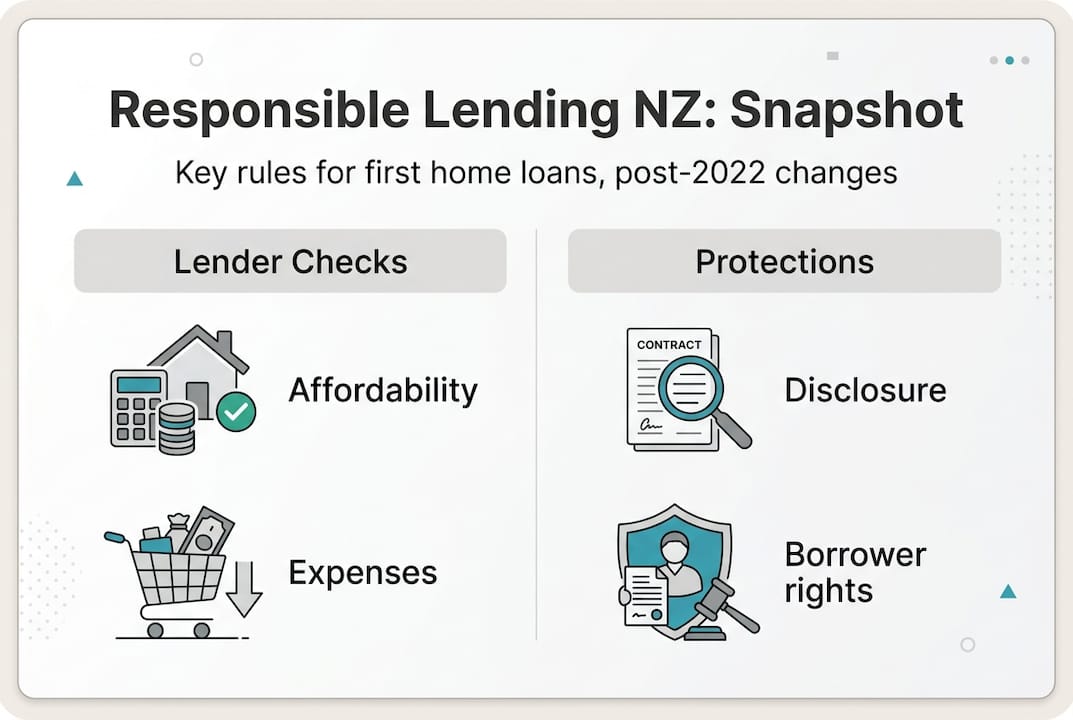
Here is how the regulatory landscape shifted:
| Period | Key change | Impact on first home buyers |
|---|---|---|
| Pre-2021 | Standard affordability checks | Moderate scrutiny of expenses |
| Dec 2021 | Strict line-by-line expense review | Slower approvals, many declined |
| 2022 to 2023 | Relaxed verification, focus on essentials | More balanced assessment |
| 2026 | Ongoing refinement of CCCFA rules | Clearer but still rigorous process |
The practical steps lenders now follow when assessing your application include:
- Reviewing your income (salary, self-employment, rental, or other sources).
- Identifying your fixed essential expenses such as rent, utilities, and insurance.
- Assessing discretionary spending patterns from your bank statements.
- Factoring in any existing credit commitments including Buy Now Pay Later (BNPL) accounts.
- Applying income and expense buffers to stress-test repayments.
One important point: even after the 2022 relaxations, first home buyers still face close expense scrutiny. Your mortgage approval guide preparation matters more than ever. If you are worried your spending history could be a barrier, read about when home loans are out of reach and what options exist.
Affordability and expense assessment explained
Affordability assessment is where most first home buyers feel the most pressure. Lenders are not trying to catch you out. They are building a picture of your financial life to determine whether repayments are sustainable.

Lenders split your expenses into two categories:
| Expense type | Examples | How lenders treat them |
|---|---|---|
| Fixed essential | Rent, utilities, insurance, groceries | Counted directly against borrowing capacity |
| Discretionary | Dining out, gym, streaming, travel | Assessed for patterns and reduction potential |
Here is the part that surprises many buyers: BNPL and credit cards reduce your borrowing capacity even when the balance is zero. A lender sees an open credit card with a $10,000 limit as a potential $10,000 liability, regardless of whether you owe a cent. The same applies to Afterpay, Laybuy, or any other BNPL service.
The good news is that lenders are not looking for a perfect spending record. They want to see that your repayments are sustainable post-essentials, meaning after your essential costs are covered, the mortgage repayment must be manageable. There is no strict requirement for a large surplus sitting in your account each month, provided income and expense buffers have been applied.
Practical steps to prepare for expense assessment:
- Close unused credit cards and BNPL accounts at least three months before applying.
- Use a spreadsheet or budgeting app to categorise your spending clearly.
- Reduce obvious discretionary spending in the three months prior to application.
- Use the mortgage calculator at Mortgage Managers to model repayments against your real budget.
- Understand how lenders assess risk so you can present your finances in the clearest possible light.
Pro Tip: Print out three months of bank statements and highlight every expense yourself before a lender does. You will quickly spot the items that could raise questions and have time to address them before your application.
Lender obligations and borrower protections
Responsible lending is not a one-way street. While lenders assess you, they also carry significant legal obligations toward you. Knowing your rights is just as important as knowing your finances.
Before you sign any credit contract, your lender must provide full disclosure of all terms, fees, interest rates, and conditions. This is not optional. The disclosure rules enforced by the Commerce Commission are clear: if a lender fails to disclose required information, you may be entitled to claim back interest and fees paid until the issue is corrected.
Your key protections as a borrower include:
- Right to full disclosure: All contract terms must be explained before you sign.
- Right to redress: If disclosure obligations are breached, you can claim refunds on interest or fees.
- Ongoing protection: Borrower protections remain active until the lender corrects the breach.
- Enforcement: The Commerce Commission actively monitors and enforces these obligations.
“Lender obligations under the CCCFA are not just administrative formalities. They are enforceable rights that protect you from being misled or overcharged.”
If you have had credit issues in the past, understanding your rights is especially valuable. Learning how to rebuild credit for a mortgage is a practical starting point. For a broader view of the entire process, the NZ mortgage process guide walks you through every stage from application to settlement.
How to use responsible lending to your advantage
Most first home buyers see responsible lending rules as obstacles. Flip that perspective. These rules actually create a structured checklist you can use to prepare a stronger application.
The CCCFA guidelines confirm that lenders focus on sustainable repayments after essential expenses, not on whether you have a perfect financial history. That means your goal is not to look wealthy. It is to look stable and predictable.
Here is how to turn responsible lending requirements into your advantage:
- Minimise open credit accounts: Close BNPL and unused credit cards well before applying. Each open account reduces your borrowing capacity.
- Track discretionary spending: Three months of reduced discretionary spending tells a clear story to lenders.
- Prepare a clear expense summary: Compile a written list of your essential monthly expenses. Presenting this proactively shows organisation and transparency.
- Aim for the right loan, not the biggest loan: Borrowing at the absolute maximum leaves no room for life events. Sustainable repayments protect your lifestyle.
- Explore all lender options: Peer to peer lending and specialist lenders may offer solutions that traditional banks cannot, particularly if your situation is non-standard.
Getting mortgage pre-approval in NZ before you start house hunting is one of the smartest moves you can make. Pre-approval forces you to go through the affordability assessment early, giving you time to address any issues before you find a property you love.
Pro Tip: Do not apply to multiple lenders at once. Each application triggers a credit enquiry, and multiple enquiries in a short period can lower your credit score and raise red flags for lenders.
Expert help: Mortgage brokers and advisers in New Zealand
Navigating responsible lending rules on your own is possible, but it is genuinely harder without expert guidance. A mortgage adviser does not just find you a loan. They help you understand exactly what lenders are looking for and position your application to meet those requirements.

At Mortgage Managers, our mortgage advisers work with a wide range of lenders, including banks and non-bank options, to find solutions that fit your actual financial situation. We understand the CCCFA inside out and know how different lenders interpret affordability assessments. Our Auckland mortgage adviser team is based in Hobsonville and services buyers across West Auckland, the North Shore, and remotely throughout New Zealand. Whether you are just starting out or have had a previous application declined, understanding the role of advisers in home buying can make a significant difference to your outcome. Get in touch with us to start a conversation about your first home loan.
Frequently asked questions
What expenses do banks check for responsible lending?
Lenders separate essential expenses such as utilities and insurance from discretionary spending like gym memberships and dining out. BNPL and credit cards are also counted against your borrowing capacity even when the balance is zero.
Can I get a home loan if I have Buy Now Pay Later accounts?
Yes, but BNPL accounts reduce how much you can borrow even if the balance is zero, because lenders treat the available credit as a potential liability.
What happens if a lender breaches responsible lending laws?
If a lender fails to meet full disclosure obligations, you may be entitled to refunds on interest and fees paid until the breach is corrected by the lender.
Do I need a ‘reasonable surplus’ on top of expenses to qualify?
A reasonable surplus is not strictly required if lenders apply appropriate buffers to income and expenses, but your repayments must be demonstrably sustainable after essential costs.
How do mortgage advisers help with responsible lending?
Mortgage advisers guide you through the CCCFA requirements, help prepare your application documents, and identify lenders whose criteria best match your financial situation.