
Over 60% of Australian borrowers admit confusion about the low deposit home loan process. For first home buyers, getting each step right could be the difference between approval and disappointment. Understanding how your deposit funds, documentation, and lender options work together gives you the confidence to stand out in a competitive New Zealand property market. This guide breaks down each stage so you can approach your home purchase feeling clear, organised, and ready to move forward.
Table of Contents
- Stage 1: Assess Your Deposit Funds and Eligibility
- Stage 2: Gather Required Documentation and Financial Proof
- Stage 3: Compare Lender Options for Low Deposit Loans
- Stage 4: Submit Your Application with Lender Support
- Stage 5: Verify Approval and Finalise Settlement Details
Quick Summary
| Key Point | Explanation |
|---|---|
| 1. Assess Financial Readiness | Understand your savings and eligibility for low deposit loans to approach mortgage applications confidently. |
| 2. Gather Essential Documentation | Collect necessary financial records to showcase your stability, including recent payslips and tax returns. |
| 3. Compare Lender Options Strategically | Research different lenders’ criteria and loan terms to find the best fit for your financial situation. |
| 4. Submit Application Thoroughly | Ensure all documentation is accurate and present a strong financial narrative to lenders before submission. |
| 5. Verify Approval and Settle Carefully | Review loan terms and conditions meticulously; maintain clear communication with lenders for a smooth settlement process. |
Stage 1: Assess Your Deposit Funds and Eligibility
Successfully navigating the low deposit home loan process starts with a clear understanding of your financial readiness. Knowing exactly where you stand financially helps you confidently approach mortgage applications and determine whether you qualify for specialised lending options.
To begin assessing your deposit funds, calculate your current savings and evaluate how they align with home deposit requirements in New Zealand. The New Zealand Government provides opportunities for first home buyers through Kāinga Ora’s First Home Loan, which allows eligible buyers to purchase a home with as little as a 5% deposit. This means if you have been diligently saving, you might already be closer to homeownership than you realised.
Carefully review your financial documents including bank statements, income records, and existing debts. Lenders will scrutinise your financial health, so transparency and preparation are key. Pro tip: Aim to demonstrate consistent savings behaviour and a stable income history. The stronger your financial profile, the more likely you are to secure a low deposit mortgage with favourable terms. Your next step will involve comparing specific loan options that match your unique financial circumstances.
Stage 2: Gather Required Documentation and Financial Proof
Preparing a comprehensive documentation package is crucial for successfully securing a low deposit home loan. This stage involves collecting and organising critical financial records that will demonstrate your lending worthiness to potential mortgage providers.
Start by gathering essential financial documents including comprehensive mortgage application checklists to ensure you have everything required. You will need recent payslips (typically the last three months), tax returns for the past two years, bank statements showing consistent savings patterns, proof of current employment, identification documents, and a detailed record of all existing debts and financial obligations. Lenders will scrutinise these documents to assess your financial stability and capacity to manage mortgage repayments.
Pro tip: Create digital and physical copies of all documentation and organise them chronologically. Maintain a clear, transparent financial narrative that shows responsible money management. Unexpected gaps or inconsistencies in your documentation can significantly delay your mortgage approval process. Your next step involves carefully reviewing these documents to ensure accuracy and completeness before submitting your loan application.
Stage 3: Compare Lender Options for Low Deposit Loans
Comparing lender options for low deposit loans is a strategic process that requires careful research and understanding of different financial institutions lending criteria. This stage is crucial in finding the most suitable mortgage that aligns with your financial circumstances and homeownership goals.

Begin by exploring comprehensive low deposit home loan guides that provide insights into various lending options available in New Zealand. Focus on comparing interest rates, loan terms, application requirements, and specific conditions for low deposit mortgages across different banks and financial institutions. Pay close attention to each lender’s unique assessment criteria for low deposit loans some may have more flexible requirements than others. Consider factors like minimum deposit percentages, additional fees, repayment flexibility, and potential first home buyer support programmes.
Pro tip: Create a comparison spreadsheet to track different lenders offerings side by side. This visual approach will help you objectively evaluate and contrast loan options, making it easier to identify the most advantageous mortgage for your specific financial situation. Remember that the cheapest option is not always the best focus on overall value and long term financial implications. Your next step involves narrowing down your options and preparing for initial loan consultations with selected lenders.
Stage 4: Submit Your Application with Lender Support
Submitting your low deposit loan application marks a critical milestone in your homeownership journey. This stage requires precision, thoroughness and strategic engagement with potential lenders to maximise your chances of mortgage approval.
Begin by learning how to prepare a comprehensive mortgage application that showcases your financial reliability. Carefully review all documentation to ensure accuracy and completeness before submission. Prepare a compelling narrative that highlights your financial stability professional income and consistent savings behaviour. When meeting with lenders be transparent about your financial history and demonstrate proactive financial management. Some lenders specialise in low deposit loans and may offer more flexible assessment criteria tailored to first home buyers.
Pro tip: Before final submission double check your bank statements and financial records to confirm they present a positive financial profile. Unexpected discrepancies or incomplete information can significantly delay your application processing. Your goal is to present a clear confident financial picture that reassures lenders of your ability to manage mortgage repayments. Your next step involves carefully tracking your application and being prepared to promptly respond to any additional information requests from potential lenders.
Stage 5: Verify Approval and Finalise Settlement Details
Reaching the final stages of your low deposit home loan journey requires meticulous attention to detail and careful verification of all settlement requirements. This critical phase transforms your mortgage application from a theoretical process into a concrete path to homeownership.
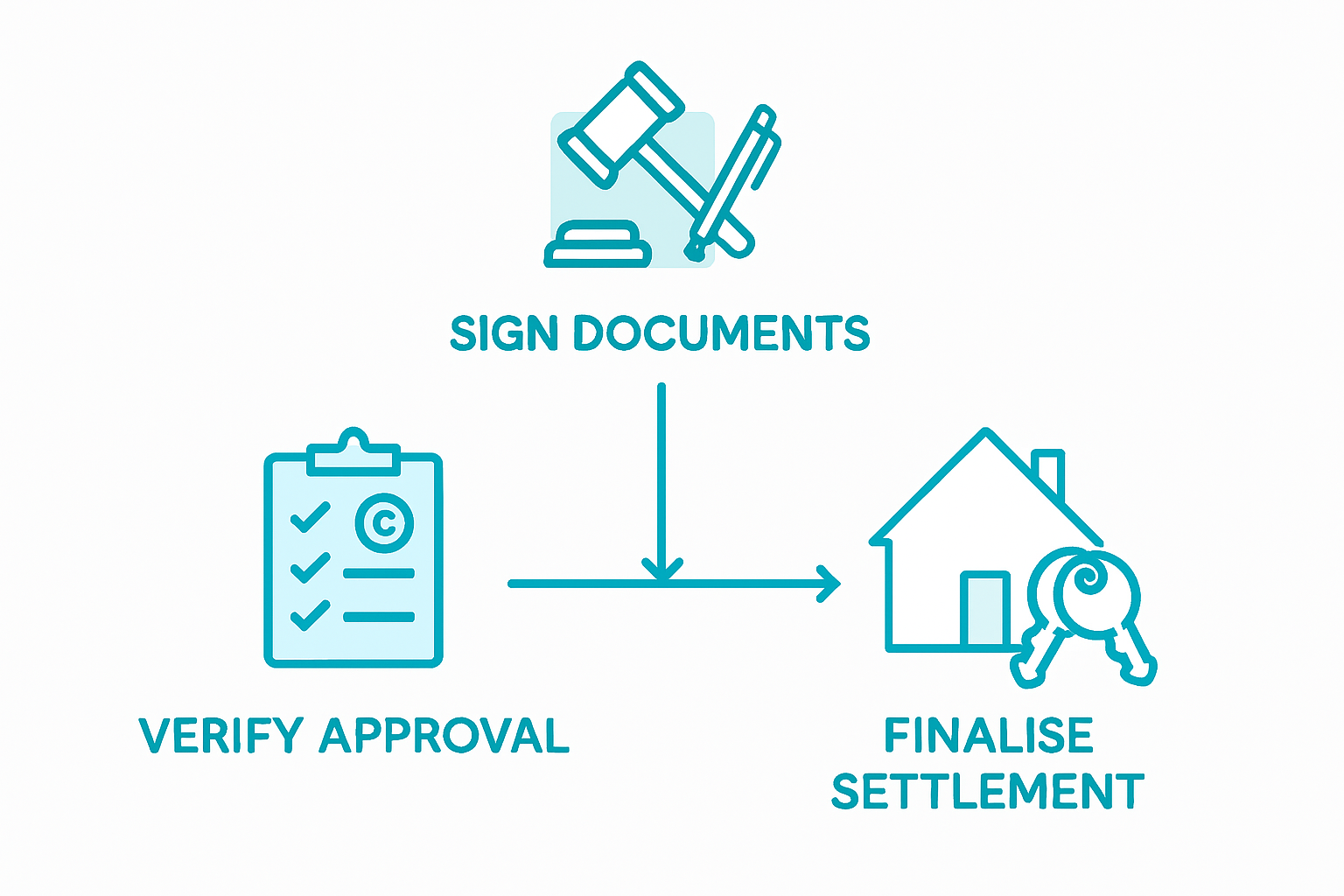
Start by thoroughly reviewing your mortgage application and approval documentation to confirm all terms and conditions match your expectations. Carefully examine interest rates loan duration settlement dates and any specific conditions attached to your low deposit mortgage. Schedule a comprehensive consultation with your lender to discuss each aspect of the loan agreement and clarify any potential questions or uncertainties. Confirm that all financial calculations align with your initial discussions and that you fully understand your repayment obligations.
Pro tip: Create a comprehensive checklist of all settlement requirements and documentation needed for property transfer. Maintain open communication with both your lender and legal representative to ensure a smooth settlement process. Unexpected complications can arise during this stage so proactive preparation and detailed verification are essential. Your final goal is to complete the settlement with absolute confidence in your financial commitment and future homeownership journey.
Get Expert Support to Navigate Your Low Deposit Home Loan Journey
Understanding the challenges of securing a low deposit home loan in New Zealand can be overwhelming. From assessing your deposit funds and preparing detailed financial documentation to comparing lender options and managing your application, every step requires clear guidance. If you are aiming to master this process and create a confident path to homeownership, expert advice customised to your financial situation can make all the difference.

Mortgage Managers are trusted mortgage advisers based in Hobsonville offering personalised support across Auckland and nationwide. We specialise in helping first home buyers and low deposit loan applicants by simplifying complex requirements and connecting you with lenders who understand your unique needs. Don’t let uncertainty delay your dream. Visit Mortgage Managers today and discover how our expertise can transform your home loan journey. Start by exploring how we prepare your mortgage application with care at Mortgage Application Preparation and learn valuable insights from our Low Deposit Home Loan Guide. Take confident steps now towards securing your home with expert advice.
Frequently Asked Questions
What is the minimum deposit required for a home loan in New Zealand?
A minimum deposit of 5% is typically required for a home loan in New Zealand, especially for first home buyers using specific lending options. Evaluate your savings to determine if you meet this requirement, and consider additional expenses such as legal fees when budgeting.
How can I demonstrate my financial stability to lenders?
To show financial stability, gather recent payslips, bank statements, and proof of employment. Ensure your documents highlight a consistent savings pattern and a strong income history.
What documents do I need to prepare for my low deposit loan application?
You’ll need payslips for the last three months, tax returns for the past two years, bank statements, proof of employment, and documentation of existing debts. Organise these documents chronologically to present a clear picture to your lender.
How can I compare different lenders for low deposit home loans?
Create a comparison spreadsheet tracking interest rates, loan terms, and application requirements of various lenders. This will help you objectively evaluate different options and identify the best fit for your financial situation.
What should I do after submitting my low deposit loan application?
After submitting your application, track its progress and be ready to provide any additional information requested by your lender. Stay organised and maintain open communication to avoid delays in the approval process.
What steps should I take upon receiving mortgage approval?
Once you receive mortgage approval, thoroughly review your loan terms and settlement requirements. Create a checklist of all documents needed for property transfer and ensure you understand your repayment obligations before proceeding to settlement.