
Many first-time homebuyers in New Zealand believe mortgage brokers add hidden costs to home loans. In reality, over 70% of Kiwi first-home buyers use brokers to access better loan deals at no direct cost to themselves. Brokers provide expert guidance, help navigate low deposit and bad credit challenges, and unlock government schemes that make homeownership achievable. This guide explains how mortgage brokers work, what they offer, and how to leverage their expertise for your first home purchase.
Table of Contents
- What Is A Mortgage Broker And How Do They Help First-Time Buyers?
- Understanding Low Deposit Home Loans And Government Schemes
- Loan-To-Value Ratio (LVR) Rules And Their Impact
- Options For Borrowers With Bad Credit And Flexible Lending
- Common Misconceptions About Mortgage Brokers And Low Deposit Loans
- Practical Steps To Secure A Low Deposit Mortgage Through A Broker
- Summary: How Mortgage Brokers Empower First-Time Buyers In NZ
- Find Expert Mortgage Brokers To Secure Your First Home
Key takeaways
| Point | Details |
|---|---|
| Broker access | Mortgage brokers connect you to 15-25+ lenders, dramatically expanding your loan options beyond single bank panels. |
| Government support | First Home Loan schemes allow eligible buyers to purchase with just 5% deposit backed by Kāinga Ora. |
| Hidden costs | Low deposit loans incur Lender’s Mortgage Insurance and additional fees that increase total borrowing costs. |
| Bad credit solutions | Brokers match borrowers with specialist lenders who accept challenging credit histories, improving approval odds. |
| Qualification matters | Not all buyers qualify for government low deposit schemes due to income caps and property value limits. |
What is a mortgage broker and how do they help first-time buyers?
A mortgage broker acts as an intermediary between you and lenders, searching across multiple banks and non-bank lenders to find suitable home loan options. Unlike walking into a single bank, mortgage brokers provide access to 15-25+ lenders compared to banks’ single lending panels. This broader access dramatically improves your chances of securing competitive rates and terms.
The service comes at no direct cost to you. Brokers earn commissions from lenders when loans settle, meaning you receive expert advice without upfront fees. For first-time buyers facing tight budgets, this free professional guidance proves invaluable.
Brokers offer tailored advice based on your financial situation, employment type, credit history, and deposit size. They identify which lenders suit your circumstances best, particularly crucial if you’re pursuing low deposit loans or managing credit challenges. A mortgage broker guide NZ shows brokers typically save clients over 20 hours by handling paperwork, negotiations, and lender communications.
Key benefits for first-home buyers include:
- Access to wholesale rates not advertised publicly
- Expert navigation of LVR rules and government schemes
- Pre-screening to avoid declined applications damaging your credit
- Ongoing support through settlement and beyond
- Time savings on research and applications
Pro Tip: Engage a broker before you start house hunting to understand your true borrowing capacity and avoid disappointment from conditional offers you can’t finance.
Understanding low deposit home loans and government schemes
New Zealand’s First Home Loan scheme allows eligible first-time buyers to purchase with a 5% deposit backed by Kāinga Ora. This government support reduces the traditional 20% deposit barrier, making homeownership accessible sooner. However, strict eligibility criteria apply that many buyers overlook.
To qualify for the First Home Loan, you must meet these requirements:
- Be a first-home buyer or in similar circumstances (previous ownership ended through relationship separation)
- Intend to live in the property as your primary residence
- Meet income caps (vary by location and number of buyers)
- Purchase within property price caps set by region
- Secure a participating lender’s approval
Beyond the 5% deposit, buyers face additional costs that catch many unprepared. Lender’s Mortgage Insurance (LMI) typically adds 1-3% of the loan value as a one-off fee when borrowing above 80% LVR. Lender establishment fees, legal costs, and insurance premiums further increase upfront expenses.
| Scheme | Minimum Deposit | Income Cap (Single) | Property Cap (Auckland) | Additional Costs |
|---|---|---|---|---|
| First Home Loan | 5% | $95,000 | $925,000 | LMI, lender fees |
| First Home Grant | 5% | $95,000 | $925,000 | None (grant only) |
| Welcome Home Loan | 10% | $85,000 | $650,000 | LMI, lender fees |
| Standard Low Deposit | 10-15% | No cap | No cap | LMI, higher rates |
Brokers help you understand which schemes suit your situation and which low deposit home loans NZ lenders offer the most competitive terms. They also identify low deposit lenders examples that accept your income type, such as self-employment or contract work.
Pro Tip: Calculate your total upfront costs including LMI and fees before making purchase offers to avoid financing gaps that delay or derail settlements.
Full First Home Loan scheme details outline regional variations and application processes.
Loan-to-value ratio (LVR) rules and their impact
LVR rules imposed by the Reserve Bank of New Zealand restrict how many high-LVR loans banks can write. Banks limit loans with LVR above 80% to 20% of their lending, with new builds having more flexible terms. This means lenders have limited capacity for low deposit borrowers, making competition fierce.

High LVR loans face stricter criteria beyond standard lending rules. Banks scrutinise income stability, employment history, credit scores, and spending patterns more intensively. A minor credit blemish or irregular income that wouldn’t matter at 20% deposit can derail a 5% deposit application.
Your borrowing power decreases as LVR increases. Lenders apply tougher debt-to-income ratios and serviceability tests to high-LVR borrowers, often reducing the amount you can borrow compared to standard applications. This reduced capacity can price you out of your target properties.
Conditional offers help prioritise your application under LVR rules NZ restrictions. When you secure a signed sale and purchase agreement, lenders often fast-track assessments to meet settlement deadlines. Brokers use this strategically to improve approval odds.
New builds receive preferential treatment under LVR settings. Banks can lend to new builds with higher LVRs outside the 20% cap, making low deposit access easier. If you’re flexible on property type, new builds offer a strategic pathway to homeownership.
Key LVR impacts include:
- Limited lender appetite for loans above 80% LVR
- Tougher income and credit requirements
- Reduced borrowing capacity affecting property choice
- Strategic advantages from conditional offers and new builds
- Seasonal variations in lender willingness
Understanding these constraints helps set realistic expectations and improves application success rates.
Options for borrowers with bad credit and flexible lending
Bad credit significantly reduces approval chances with mainstream banks, but brokers find lenders with tolerance for past financial difficulties. Specialist and non-bank lenders assess applications holistically, considering current circumstances alongside credit history. Your broker’s knowledge of which lenders accept what credit issues proves crucial.
Specialist lenders offer higher risk loans at premium interest rates. Expect rates 1-3% above standard bank rates, reflecting increased lender risk. While more expensive, these loans provide a pathway to homeownership that mainstream banks deny, with opportunities to refinance once credit improves.
Brokers improve approval odds through suitable lender matching and application management. They know which lenders accept defaults, bankruptcies, or credit enquiries, saving you from multiple declined applications that further damage credit scores. Strategic application sequencing maximises success probability.
Understanding tradeoffs helps set realistic cost expectations. Higher interest rates increase monthly repayments and total interest paid over the loan term. However, establishing positive repayment history rebuilds credit, opening refinancing opportunities within 12-24 months at better rates.
Key considerations for bad credit borrowers:
- Full credit disclosure to your broker prevents surprises
- Specialist lenders charge 1-3% premium rates
- Larger deposits improve approval chances
- Stable employment strengthens applications
- Debt consolidation may improve serviceability
Pro Tip: Request a credit report before engaging a broker to understand what lenders will see, then work with your broker to address issues proactively and position your application favourably.
Explore non-bank lenders for bad credit that brokers access.
Common misconceptions about mortgage brokers and low deposit loans
Many buyers believe mortgage brokers charge fees that increase borrowing costs. In New Zealand, brokers typically receive commission from lenders, making their service free to homebuyers. You receive expert advice, lender access, and application support without direct payment, though brokers do have financial incentives tied to loan placement.
First-time buyers often assume 5% deposit loans cost the same long-term as 20% deposit loans. Low deposit loans typically cost substantially more due to Lender’s Mortgage Insurance premiums, higher interest rates, and additional lender fees. Over a 30-year term, these costs can add tens of thousands of dollars to total repayments.
The misconception that government schemes guarantee approval misleads many applicants. Meeting income and property price caps doesn’t ensure approval. Lenders still assess creditworthiness, employment stability, and debt serviceability. Not all buyers who qualify for schemes receive lender approval.
Some buyers believe brokers guarantee loan approval regardless of circumstances. Brokers significantly improve approval odds through lender matching and application quality, but they can’t override lender criteria. Declined applications occur when borrowers don’t meet minimum lender standards.
| Myth | Reality |
|---|---|
| Brokers charge buyer fees | Most NZ brokers are paid by lenders at no direct cost to buyers |
| 5% deposit = same cost | Low deposit loans cost more due to LMI, fees, and higher rates |
| Government schemes guarantee approval | Schemes reduce deposit barriers but lenders still assess creditworthiness |
| Brokers only work with banks | Brokers access non-bank lenders offering flexible criteria |
| All brokers offer same service | Broker quality varies; choose experienced, licensed professionals |
Key realities buyers should understand:
- Free broker service doesn’t mean no conflicts; brokers earn more from certain lenders
- Total cost of borrowing increases significantly with low deposits
- Approval depends on meeting lender criteria, not just scheme eligibility
- Broker value comes from market knowledge and lender relationships
Understanding these truths helps you engage brokers effectively and set realistic expectations for your home loan journey.
Practical steps to secure a low deposit mortgage through a broker
Successfully securing a low deposit mortgage requires systematic preparation and strategic engagement. Follow these steps to maximise your approval chances and minimise delays.
-
Assess your financial position by reviewing income stability, savings for deposit and costs, existing debts, and credit history. Request a credit report to identify issues needing attention.
-
Engage a licensed mortgage broker early, ideally 3-6 months before you plan to buy. This timeline allows addressing credit issues, building savings, and understanding true borrowing capacity.
-
Discuss government scheme eligibility with your broker to determine if First Home Loan, First Home Grant, or Welcome Home Loan suits your circumstances. Clarify income caps, property limits, and documentation requirements.
-
Prepare financially by reducing unnecessary debts, avoiding new credit applications, maintaining stable employment, and saving for deposit plus additional costs including LMI and fees.
-
Obtain mortgage pre-approval through your broker before house hunting. Pre-approval demonstrates serious buyer status to vendors and speeds settlement once you find a property.
-
Submit conditional purchase offers that include finance clauses protecting you if final approval doesn’t eventuate. Work closely with your broker during due diligence periods.
-
Provide thorough documentation promptly when lenders request information. Delays in supplying payslips, bank statements, or identification slow approvals and risk settlement breaches.
Essential documents to prepare include:
- Three months of payslips or two years of tax returns for self-employed
- Six months of bank statements showing savings and spending patterns
- Identification including driver licence and passport
- KiwiSaver statements if using for deposit
- Employment contracts or letters confirming position and income
Pro Tip: Maintain open communication with your broker throughout the process, asking questions when uncertain rather than making assumptions that could derail your application or delay settlement.
Learn the complete low deposit loan steps NZ process to prepare effectively.
Summary: how mortgage brokers empower first-time buyers in NZ
Mortgage brokers transform the home-buying experience for first-time buyers facing deposit and credit challenges. Their access to 15-25+ lenders creates competition that improves rates and terms beyond what single banks offer. This expanded choice proves particularly valuable when pursuing low deposit loans where bank appetite remains limited.
Government schemes reduce deposit barriers to as low as 5%, but qualification requirements and additional costs require careful navigation. Brokers guide you through eligibility assessments, cost calculations, and lender selection to maximise scheme benefits while managing financial tradeoffs.
Understanding and managing loan costs separates successful buyers from disappointed applicants. Brokers explain LVR impacts, LMI premiums, and interest rate variations, helping you budget accurately and avoid financing gaps. This cost transparency prevents settlement delays and unexpected expenses.
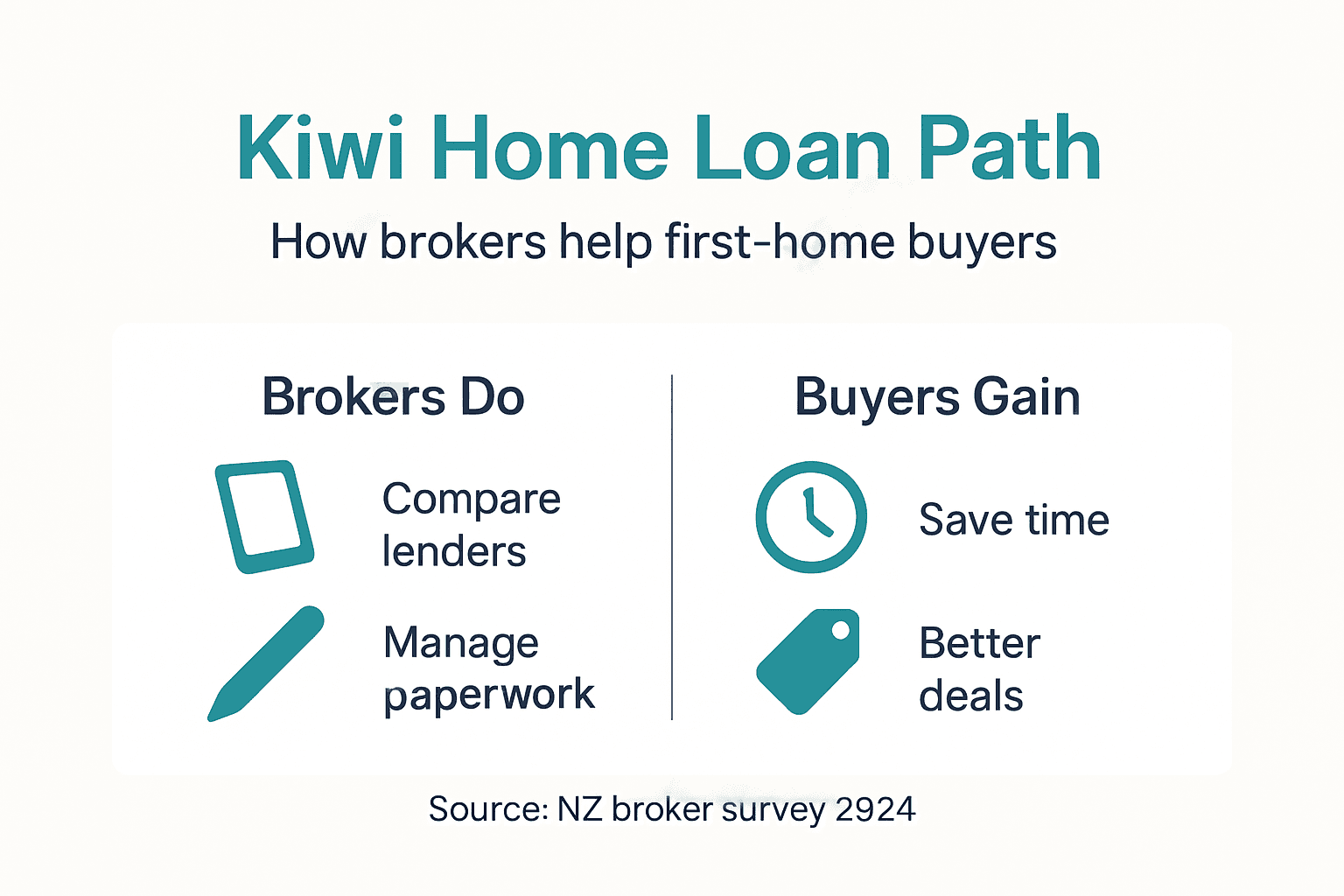
Using a broker saves substantial time researching lenders, comparing products, and managing applications. The typical 20+ hours saved allows you to focus on property search and purchase negotiations while your broker handles technical lending complexities.
Key empowerment factors include:
- Broader lender access improving approval odds
- Expert guidance through government schemes
- Realistic cost expectations preventing surprises
- Time savings on research and applications
- Ongoing support from application through settlement
Whether facing low deposit constraints, credit challenges, or simply seeking best-value loans, consulting an experienced mortgage broker significantly improves your path to homeownership. Their market knowledge and lender relationships create opportunities that direct bank applications often miss.
Find expert mortgage brokers to secure your first home
Now that you understand how mortgage brokers unlock homeownership for first-time buyers, it’s time to connect with experts who can guide your journey. Mortgage Managers offers specialist mortgage adviser services throughout Auckland and New Zealand, providing access to lender panels far beyond traditional banks.

Our personal mortgage advisers work as your advocates, navigating low deposit requirements, government schemes, and credit challenges to secure suitable home loans. We understand the Auckland market intimately and maintain relationships with specialist lenders who consider applications mainstream banks decline. Our locally owned Hobsonville team brings personalised service and genuine care to every client relationship.
Whether you’re working with a 5% deposit, rebuilding credit, or seeking competitive rates, our expert mortgage brokers NZ simplify the complex lending landscape. We handle paperwork, negotiate terms, and keep your application moving efficiently toward settlement. Our success comes from matching borrowers with the right lenders based on deep market knowledge.
Learn more about the mortgage broker role NZ and how we support first-home buyers across West Auckland, North Shore, and beyond.
FAQ
Can I use a mortgage broker if I have bad credit?
Yes, mortgage brokers specialise in helping borrowers with credit challenges by identifying lenders for bad credit who assess applications holistically. They know which specialist and non-bank lenders accept defaults, bankruptcies, or poor credit scores, significantly improving your approval chances compared to direct bank applications.
Are mortgage broker services free for first-time homebuyers?
In New Zealand, mortgage brokers are typically paid commissions by lenders when loans settle, making their services free at the point of use for homebuyers. You receive expert advice, lender access, and application support without direct fees, though some brokers charge for complex situations.
What documents do I need to provide to a mortgage broker?
You’ll need proof of income such as three months of payslips or two years of tax returns for self-employed individuals, plus six months of bank statements showing savings and spending patterns. Also prepare identification documents, employment contracts, and KiwiSaver statements if using those funds. Complete documents for mortgage application requirements vary by lender and loan type.
How do government schemes help with low deposit mortgages?
Government schemes like the First Home Loan reduce deposit requirements to as low as 5% by providing lender guarantees through Kāinga Ora, removing traditional 20% barriers. However, eligibility includes income caps, property price limits, and owner-occupier requirements that restrict who qualifies. Explore government low deposit schemes NZ to understand which programmes suit your circumstances.