
TL;DR:
- Nearly half of Kiwis are unaware of their credit scores, which are crucial for mortgage approval.
- A higher credit score improves approval chances and secures better mortgage interest rates.
- Responsible financial behavior and regular credit report checks can significantly improve your score.
Nearly 46% of Kiwis have no idea what their credit score is, yet it’s one of the first things a lender looks at when you apply for a home loan. If you’re a first home buyer in New Zealand, that number can feel like a mystery wrapped in financial jargon. But it doesn’t have to be. Your credit score is actually one of the most controllable parts of your mortgage application, and understanding it now gives you a genuine head start. This guide breaks down how NZ credit scores work, what they mean for your home loan, and exactly what you can do to put yourself in the best possible position.
Table of Contents
- What is a credit score and how does it work in NZ?
- How your credit score impacts your mortgage application
- What affects your NZ credit score — and common pitfalls
- How to check, understand, and improve your NZ credit score
- Our perspective: what most first home buyers get wrong about credit scores
- How we can help you secure your first home
- Frequently asked questions
Key Takeaways
| Point | Details |
|---|---|
| Credit score basics | NZ scores are calculated by Centrix, Equifax, and Illion, and a solid score can open more mortgage options. |
| Impact on home buying | Lenders use your credit score to help decide your eligibility and mortgage rates. |
| Improvement is possible | Simple steps—like paying bills on time—can quickly boost your score as a first home buyer. |
| Check for free | You can check your score online with all three agencies at no cost. |
What is a credit score and how does it work in NZ?
Think of your credit score as a financial report card. It’s a number that summarises how reliably you’ve managed debt and financial commitments in the past. Lenders use it to quickly assess how risky it might be to lend you money. The higher your score, the more confident a lender feels about approving your mortgage.
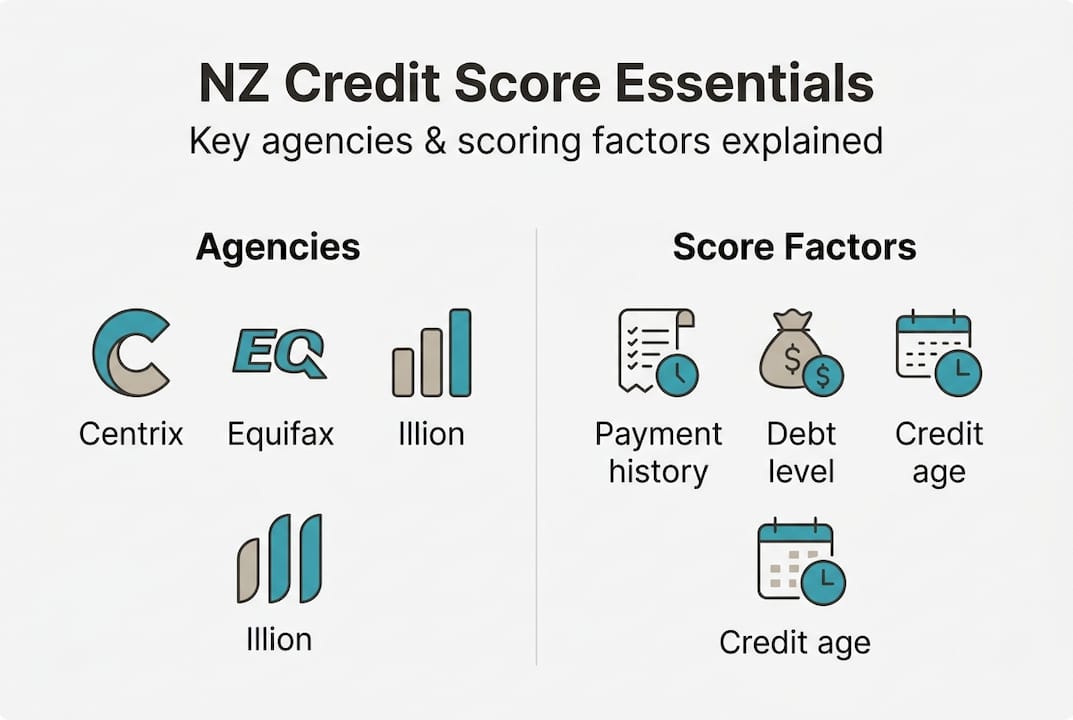
In New Zealand, three main credit reporting agencies compile and maintain your credit information: Centrix, Equifax, and Illion. Each agency uses a slightly different scoring scale, but most operate within a range of 0 to 1,000 or 0 to 1,200. The national average sits around 752, which gives you a useful benchmark to measure yourself against.
Here’s a general guide to how score bands typically look across NZ agencies:
| Score range | Rating | What it means for you |
|---|---|---|
| 800 and above | Excellent | Strong approval odds, best rates |
| 700 to 799 | Good | Solid options with most lenders |
| 500 to 699 | Average | Approval possible, fewer choices |
| Below 500 | Low | Limited options, specialist help needed |
Your score is shaped by several factors, including your payment history, how much credit you’re using, the length of your credit history, and any recent applications for new credit. One important thing to know is that NZ introduced positive credit reporting in recent years. This means on-time payments and responsible credit use are now recorded, not just the bad stuff. That’s genuinely good news for first home buyers working to build their file.
Common myths worth busting:
- “Checking my score will lower it” — not true for self-checks (more on this shortly)
- “I have no debt, so my score must be great” — actually, no credit history can work against you
- “One missed payment won’t matter” — it does, especially in the short term
Understanding how credit score affects home loans is the foundation of smart mortgage planning. And knowing why credit history matters before you apply can save you a lot of stress down the track.
Pro Tip: Don’t wait until you’re ready to buy to check your score. Start at least 12 months out so you have time to address anything that needs attention.
How your credit score impacts your mortgage application
Now that you know what a credit score is, it’s time to see why it matters for getting your home loan. When you apply for a mortgage, your lender isn’t just looking at your income and deposit. They’re building a picture of your overall financial reliability, and your credit score is a central piece of that picture.

A higher score opens doors. It means more lenders will consider your application, and those lenders are more likely to offer you competitive interest rates. Even a small difference in your rate can add up to thousands of dollars over the life of a 25 or 30-year mortgage. That’s why your credit score isn’t just a number. It’s a financial lever.
Here’s a simplified comparison of how different score bands can affect your mortgage outcome:
| Credit score band | Likely lender options | Rate impact | Approval likelihood |
|---|---|---|---|
| Excellent (800+) | Mainstream banks + more | Lowest available | Very high |
| Good (700-799) | Most mainstream lenders | Competitive | High |
| Average (500-699) | Some banks, non-bank lenders | Moderate premium | Moderate |
| Low (below 500) | Specialist lenders only | Higher rates | Requires tailored advice |
Your credit score doesn’t work in isolation, though. Lenders weigh it alongside:
- Your income stability and employment history
- The size of your deposit (typically 10% to 20% for first home buyers)
- Your existing debts and monthly expenses
- Your overall spending behaviour from bank statements
One key insight: payment history is the biggest factor, worth around 35% of your overall score. That means consistently paying your bills on time is the single most powerful thing you can do. It sounds simple, but it’s often the area where people slip up without realising the consequences.
If your score isn’t where you’d like it to be, it’s not the end of the road. Explore approval tips for bad credit or learn more about bad credit home loans to understand your full range of options.
Statistic to remember: A borrower with an excellent credit score could save tens of thousands of dollars in interest over the life of their loan compared to someone with a low score, simply due to the difference in the rate offered.
What affects your NZ credit score — and common pitfalls
Understanding impact is one thing, but what actually moves your score up or down? Let’s get specific, because this is where many first home buyers make avoidable mistakes.
Factors that help your score:
- Paying all bills and loan repayments on time, every time
- Keeping your credit card balances well below their limits
- Maintaining long-standing credit accounts in good standing
- Having a mix of credit types (e.g., a credit card and a personal loan managed responsibly)
Factors that hurt your score:
- Missing payments or paying late, even by a few days
- Carrying high credit card balances, particularly above 30% utilisation
- Applying for multiple credit products in a short period (each application creates a ‘hard enquiry’)
- Defaults, judgements, or accounts sent to collections
There are also some less obvious pitfalls that catch Kiwi buyers off guard. Frequent address changes can raise flags in your credit file because they create inconsistencies. A ‘thin file’, meaning you have very little credit history at all, can also work against you. Some agencies may default thin files to a lower risk assessment, but others may simply have insufficient data to score you confidently.
“The biggest risk for young buyers isn’t bad credit. It’s no credit. Lenders need a track record to assess you, and a blank page tells them very little.”
This is why building even a modest credit history before you apply for a mortgage is genuinely worthwhile. A credit card used for small purchases and paid off in full each month is one of the most effective tools available to you.
Pro Tip: If you’re planning to buy in the next year or two, start fixing your credit before buying now. Even small improvements compound over time. Check out these credit score tips for buyers for a practical action list.
How to check, understand, and improve your NZ credit score
Armed with knowledge of what influences your score, here’s how you can take control, starting today. The good news is that nearly half of Kiwis haven’t yet checked their score, which means taking this step immediately puts you ahead of the curve.
Step-by-step: how to get your credit report
- Visit the websites of Centrix, Equifax NZ, and Illion directly
- Request your free credit report from each agency (you’re entitled to one free report per year from each)
- Review each report carefully for errors, outdated information, or unfamiliar accounts
- If you spot an error, contact the agency directly to dispute it in writing
How to read what you find:
Your report will show your score, a list of credit accounts, payment history, any defaults or judgements, and recent credit enquiries. Focus first on any negative listings. Even one default can significantly drag your score down, and getting it corrected or removed if it’s inaccurate can make a real difference.
Quick wins for improving your score:
- Set up automatic payments so you never miss a due date
- Pay down credit card balances to below 30% of the limit
- Avoid applying for new credit in the six months before your mortgage application
- Close any unused credit accounts that you no longer need
Ongoing habits that build a strong file over time include keeping your oldest credit account open, making more than the minimum repayment on any debt, and reviewing your credit report at least once a year. For those working to rebuild credit for a mortgage, consistency is the real game-changer. Small, steady improvements in your behaviour translate directly into score gains, often faster than you’d expect.
Pro Tip: Use the process of improving home loan eligibility as a broader financial health check. Your credit score is just one piece, but it’s a great place to start.
Our perspective: what most first home buyers get wrong about credit scores
Before you put these steps into action, consider the deeper reality most guides don’t discuss. In our experience working with first home buyers across Auckland and throughout New Zealand, the most damaging belief we encounter is this: that a low credit score is a final verdict.
It isn’t. Not even close.
NZ’s positive credit reporting system means that recent, responsible behaviour carries real weight. A buyer who had a rough patch two years ago but has been consistently reliable since then is a very different prospect to a lender than someone whose problems are ongoing. Lenders are looking for resilience and trajectory, not perfection.
The second mistake is fixating on the number itself rather than the habits behind it. Your score is a symptom of your financial behaviour. Fix the behaviour, and the score follows. We’ve seen buyers improve their position significantly in as little as six months by doing the basics well.
If you’re feeling uncertain, a credit assessment for first home buyers with a trusted adviser can give you a clear, honest picture of where you stand and what to do next. That clarity is worth more than any amount of anxious Googling.
How we can help you secure your first home
Your credit score is one piece of the puzzle, but navigating the full mortgage process as a first home buyer can feel overwhelming. That’s where we come in.

At Mortgage Managers, we work with first home buyers every day, including those with limited credit history or past financial challenges. Our Auckland mortgage brokers understand the NZ lending landscape and know which lenders are the right fit for your situation. Whether you’re just starting to research or ready to apply, our mortgage application guide walks you through every step. For truly tailored support, our personalised mortgage advice service is designed to match you with the best possible outcome. Reach out today and let’s map your path to home ownership together.
Frequently asked questions
What credit score do you need to buy a home in NZ?
There’s no strict minimum, but a higher score gives you access to more lenders and better interest rates. Most mainstream banks prefer scores in the good to excellent range, with NZ scores typically ranging from 0 to 1,000 or 0 to 1,200 depending on the agency.
How do I check my credit score for free in New Zealand?
You can request a free credit report directly from each of the three NZ credit agencies, Centrix, Equifax, and Illion, through their websites at any time.
Will checking my credit score affect it?
No. Checking your own credit score is classified as a ‘soft’ enquiry and has no impact on your credit rating whatsoever.
What drops a NZ credit score the fastest?
Missed or late payments are the most damaging, given that payment history accounts for roughly 35% of your score. High credit card balances close behind.
Can I still get a mortgage in NZ with bad credit?
Yes, it’s possible. Specialist lenders and experienced mortgage brokers can often find solutions for buyers with low or poor credit scores, especially where there’s a clear pattern of recent improvement.