
TL;DR:
- Many homeowners in New Zealand are remortgaging to secure better rates and reduce costs.
- Preparation, understanding costs, and comparing offers are crucial for a successful remortgaging process.
- Timing and strategic structuring of the loan maximize savings and support long-term financial goals.
Rising mortgage repayments have put real pressure on New Zealand homeowners, and if your fixed term is rolling off soon, you’re likely wondering whether there’s a better deal waiting for you. The good news is there almost certainly is. Record numbers of homeowners are remortgaging as fixed terms expire and savings become too significant to ignore. Whether you want to reduce your monthly repayments, tap into your home equity for an investment, or simply get a fairer rate, this guide walks you through every step of the process so you can move forward with clarity and confidence.
Table of Contents
- What to know before you remortgage
- Step one: Assess your current mortgage and goals
- Step two: Compare lenders, offers, and costs
- Step three: Application, approval, and switching process
- The real secret to successful remortgaging in New Zealand
- Expert help for your next mortgage move
- Frequently asked questions
Key Takeaways
| Point | Details |
|---|---|
| Check eligibility first | Ensure your property’s equity, payment record, and credit history meet lenders’ remortgaging criteria. |
| Know your numbers | Assess your current loan, calculate savings, and use break-even maths to justify costs. |
| Compare full costs | Focus on interest rates, fees, and flexible features to find the best overall deal. |
| Follow a clear process | Complete applications, verify legal documents, and prepare to switch for a smooth transition. |
| Professional help advantages | Mortgage advisers can streamline steps, offer access to exclusive deals, and simplify negotiations. |
What to know before you remortgage
Now that you see the potential benefits, let’s clarify what you need before starting your remortgage journey. Preparation is everything. Walking into the process without a clear picture of your financial position is a bit like navigating Auckland without a map. You can still get there, but it takes a lot longer and you’ll probably make a few wrong turns.
Before you do anything else, check these prerequisites:
- Home equity: Most lenders want you to hold at least 20% equity in your property.
- Repayment history: Being up to date on your current mortgage signals reliability to new lenders.
- Credit history: A clean credit file opens more doors and better rates.
- Income documentation: Recent payslips, tax returns, or business financials if you’re self-employed.
- Evidence of outgoings: Bank statements showing regular expenses and existing debts.
You’ll also need to understand what’s in your current mortgage agreement. Break fees and redemption penalties can eat into your savings if you exit a fixed term early. These costs vary widely, so request a break cost estimate from your current lender before you go any further. Our NZ remortgage guide explains how these fees are calculated and when they’re worth paying.
It’s equally important to define your objective upfront. Are you chasing a lower interest rate? Hoping to shorten your loan term? Or do you want to release equity for a renovation or investment property? Your goal shapes every decision that follows.
The gap between what people are paying and what’s available is significant. The average fixed rate paid was 5.8% while many new loans were being written under 5%. That’s a meaningful difference on a large loan balance. If you’ve been reviewing your mortgage and suspect you’re overpaying, you probably are.
| Factor | What to check | Why it matters |
|---|---|---|
| Equity | LVR below 80% | Unlocks better rates |
| Credit score | No defaults or arrears | Widens lender options |
| Break fees | Request from lender | Affects net savings |
| Loan objective | Rate, term, or equity | Guides product choice |
Pro Tip: If your fixed rate is above 5%, reviewing options is not just smart, it’s essential. Even a 0.5% reduction on a $600,000 loan saves around $3,000 per year.
Step one: Assess your current mortgage and goals
With the basics sorted, your first actionable task is getting clear about your current mortgage position and objectives. Think of this step as taking stock before a big move. You wouldn’t pack without knowing what you own, and you shouldn’t switch lenders without knowing exactly where you stand.
Here’s a simple process to work through:
- Find your current interest rate. Check your loan documents or call your lender. Is it fixed or floating? When does the fixed term end?
- Note your outstanding balance. This tells you the size of the loan you’re refinancing and affects which lenders will consider you.
- Identify your repayment type. Are you on principal and interest, or interest only? This affects your equity position and lender appetite.
- Estimate your property’s current value. Use recent sales in your area or get a registered valuation. This determines your loan-to-value ratio (LVR), which is the percentage of your home’s value you owe.
- List your top goals. Write them down. Save on interest? Reduce monthly repayments? Free up capital for an investment property?
Homeowners with fixed rates above the current market may save substantially by switching, especially when their fixed term is ending. Timing matters enormously here.
Once you know your numbers, use a break-even calculation to sense-check whether switching is financially sound. The formula is straightforward:
Net cost divided by annual savings equals years to recoup costs.
For example, if your total switching costs are $3,000 and you save $2,000 per year, you’ll break even in 18 months. If you plan to stay in the loan for longer than that, switching makes sense. Tools for calculating repayments can help you model different scenarios quickly. You can also explore ways to improve your loan terms beyond just the interest rate.
Pro Tip: Don’t just focus on the monthly saving. Calculate the total interest saved over the remaining loan term. On a 25-year mortgage, even a small rate reduction can save tens of thousands of dollars. The pros and cons of remortgaging are worth reading before you commit.
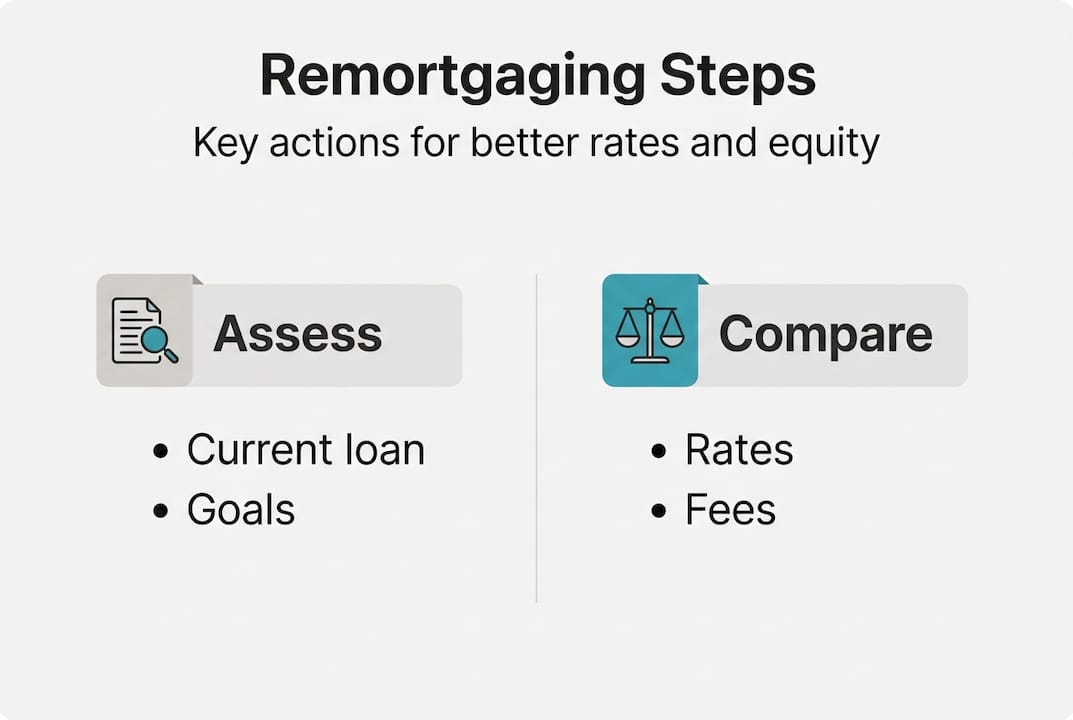
Step two: Compare lenders, offers, and costs
Once you know what you want, it’s time to see what’s actually on offer and how deals stack up. This is where many homeowners make their biggest mistake: they call one bank, get a number, and assume that’s the market. It isn’t.
You should gather quotes from at least three sources:
- Your existing bank (they may offer a retention deal to keep your business)
- Other major banks (rates and cashbacks vary significantly)
- Non-bank lenders (often more flexible on criteria and structure)
- A mortgage broker (accesses multiple lenders simultaneously and negotiates on your behalf)
Over $2.5 billion in loans were refinanced in 2025 with a clear shift toward lower-than-average rates. That tells you the market is moving, and lenders are competing for your business.
When comparing offers, look beyond the headline interest rate. Here are the elements you must evaluate:
- Total cost of switching: Break fees plus legal fees plus application fees
- Monthly minimum repayment: How does it compare to what you pay now?
- Fixed term length: Does it match your plans? Shorter terms offer flexibility, longer terms offer certainty.
- Penalties for early exit: What happens if you need to sell or switch again?
- Offset and redraw features: These can save significant interest if you hold savings alongside your loan.
- Cashback offers: Some lenders offer $2,000 to $5,000 to switch, which can offset your costs.
| Feature | Bank A | Bank B | Non-bank |
|---|---|---|---|
| Interest rate | 5.89% | 5.49% | 5.29% |
| Application fee | $0 | $250 | $500 |
| Cashback | $3,000 | $0 | $0 |
| Offset account | No | Yes | No |
| Break penalty | High | Medium | Low |
Finding the cheapest home loan rates requires looking at the full picture, not just one number. It’s also worth understanding why you should compare home loans across multiple lenders before committing.

Step three: Application, approval, and switching process
With your preferred deal chosen, let’s work through the stages of changing your loan safely and efficiently. The actual switching process is more straightforward than most people expect, especially if your paperwork is in order.
Here’s what the process typically looks like:
- Submit your application to the new lender with all required documents: ID, payslips, bank statements, and your current loan details.
- Receive conditional approval. The lender agrees in principle, subject to valuation and final checks.
- Complete a property valuation. Your new lender may require a registered valuation or use an automated estimate depending on your LVR.
- Legal work begins. A solicitor (often arranged by the lender) handles the discharge of your old mortgage and registration of the new one.
- Discharge your old loan. Your old lender releases the mortgage once the new lender settles the outstanding balance.
- Start your new repayments. Update your automatic payments and confirm your new repayment schedule.
Refinancing activity peaked as fixed terms rolled over and homeowners sought better rates. Lenders are well-practised at handling switches efficiently as a result.
Turnaround is typically two to three weeks for straightforward applications. Self-employed borrowers or property investors may face additional income verification steps, so allow extra time. If you’re switching to a bank mortgage from a non-bank lender, the process is similar but may involve slightly different criteria. Our guide on refinancing explained NZ covers the full picture.
Pro Tip: Get conditional pre-approval from your new lender before formally discharging your old loan. This protects you if anything unexpected comes up during the legal process. Also remember to notify your home and contents insurer of the change and update any automatic payments linked to your old account.
The real secret to successful remortgaging in New Zealand
While the steps above cover the mechanics, here’s an insider view on what really drives successful outcomes. Most guides focus on the checklist. We want to talk about the mindset.
The biggest mistake we see Kiwi homeowners make is treating remortgaging as a rate-shopping exercise. The interest rate matters, yes, but fees, flexibility, and loan structure can save or cost you just as much over time. A break-even analysis is often underestimated but is the true key to making the right remortgaging decision.
Timing is your other secret weapon. Switching before your fixed term ends, rather than waiting for the roll-off date, can lock in savings sooner. And negotiating hard matters. Banks want your business. Don’t accept the first offer.
The real win isn’t just a lower rate today. It’s structuring your debt to support your broader financial goals, whether that’s building an investment portfolio, paying off your home faster, or protecting your cash flow. Think future-proofing, not just today’s pressure. As we often say to our clients: it’s your loan, not the bank’s. Don’t be afraid to ask for a better deal or to walk away. Tips on managing your home loan well over time are just as valuable as the switch itself.
Expert help for your next mortgage move
If you want a smoother, more confident remortgage experience, here’s how professional help can make all the difference.

Navigating lenders, comparing offers, and managing the legal process on your own is entirely possible, but it takes time and know-how. A mortgage adviser acts like your financial GPS, doing the legwork, negotiating on your behalf, and making sure you don’t miss a better deal hiding in the market. At Mortgage Managers, we’re a locally owned Auckland team based in Hobsonville, and we work with homeowners across New Zealand remotely too. Whether you’re ready to switch or just want to sense-check your options, understanding when to get help from a professional could be the most valuable step you take.
Frequently asked questions
How long does remortgaging take in New Zealand?
The remortgaging process usually takes between two and four weeks, depending on your lender and how quickly your paperwork is submitted. Complex applications involving investment properties or self-employment can take a little longer.
Can I remortgage if my credit score isn’t perfect?
Most lenders will still consider you, but a lower credit score may result in higher rates or stricter conditions. Lenders tightened criteria for certain borrower types, so speaking with a broker who knows which lenders are more flexible is a smart move.
What fees should I watch out for when remortgaging?
The main costs to watch are break fees from your existing lender, application fees from the new lender, and legal or solicitor charges. Some lenders offer cashbacks that can offset these total switch costs significantly.
Is remortgaging worth it if I only save a small amount?
Always run a break-even calculation first. If your savings cover the switching costs before you’re likely to change loans again, it’s generally worth proceeding, even if the monthly saving looks modest.
Recommended
- Steps to refinance mortgage for better rates and terms
- How to Pay Off Mortgage Faster and Build Home Equity
- Sovereign Home Loans Provide Better Home Loan Rates
- Reaching 20% Equity: Stop Paying Low Equity Margins or High Interest Rates | Mortgage Managers
- Home Equity Can Be a Game Changer When You Sell