
TL;DR:
- Negative equity occurs when your mortgage exceeds your home’s current market value.
- It mainly becomes a concern when you need to sell or refinance in a falling market.
- Staying proactive, maintaining payments, and seeking professional advice can mitigate risks.
You’re meeting every mortgage repayment on time, your finances feel steady, and yet the value of your home has quietly dropped below what you still owe the bank. This situation catches many New Zealand homeowners off guard, because most people assume that negative equity is only a problem when you’re struggling to pay. The reality is more nuanced, and understanding it early can make an enormous difference to your financial future. This guide breaks down exactly what negative equity is, when it truly matters, how to check your own position, and what practical steps you can take if you find yourself in it.
Table of Contents
- What is negative equity and how does it happen?
- When does negative equity become a real concern?
- How to identify if you’re in negative equity
- What are your options if you’re in negative equity?
- A fresh perspective: Why negative equity isn’t always doom and gloom
- Getting help: Find the right mortgage adviser for your situation
- Frequently asked questions
Key Takeaways
| Point | Details |
|---|---|
| Negative equity basics | It means owing more on your home loan than your house is currently worth. |
| When it matters | Negative equity mostly impacts you if you need to sell or refinance. |
| Mitigating risk | Keeping up with repayments lets you ride out most negative equity situations. |
| Getting support | Mortgage advisers can help you navigate negative equity scenarios with tailored solutions. |
What is negative equity and how does it happen?
Let’s get the definition clear first. Negative equity occurs when the outstanding balance on your mortgage is higher than the current market value of your home. In simple terms, if you sold your property today, the sale price would not cover what you still owe the bank. That gap is your negative equity.
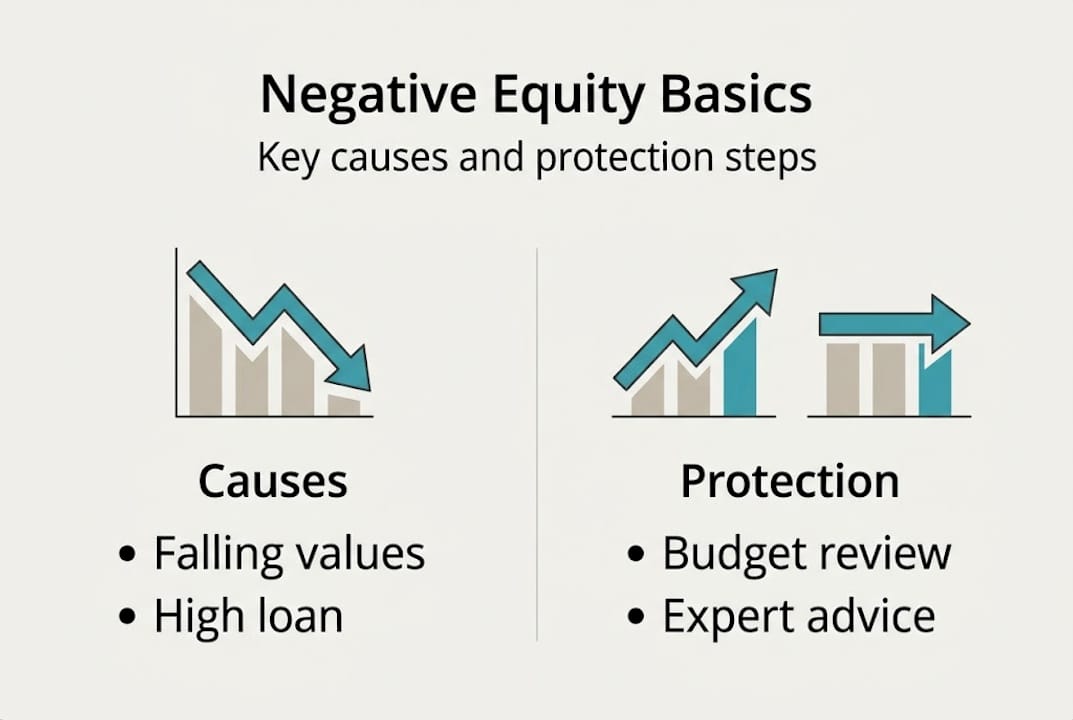
For New Zealand homeowners, negative equity typically arises when house values fall after you bought with high loan-to-value (small deposit) borrowing or during a market downturn. This is especially relevant for buyers who entered the market near the peak of a boom, which New Zealand experienced dramatically between 2020 and 2022 before values corrected sharply in subsequent years.
Understanding the property valuation impact on your equity position is essential, because your equity is not fixed. It moves up and down as market conditions shift.
Here’s a straightforward example to illustrate the concept:
| Scenario | Property value | Mortgage balance | Equity position |
|---|---|---|---|
| Positive equity | $750,000 | $500,000 | +$250,000 |
| Break-even | $600,000 | $600,000 | $0 |
| Negative equity | $520,000 | $600,000 | $80,000 |
As you can see, negative equity does not require a dramatic collapse in prices. A modest drop of 13% from $600,000 to $520,000 is enough to push a high loan-to-value borrower into negative territory.
Common triggers for negative equity in New Zealand:
- Buying at or near the peak of a property market cycle
- Purchasing with a deposit of 10% or less, leaving very little buffer
- Rapid and sustained falls in property values across a region
- Taking out a top-up loan or second mortgage that increases total debt
- Slow repayment progress on interest-only loan structures
It’s worth knowing that thousands of New Zealanders were exposed to the risk of negative equity following the property price corrections that began in 2022, when national median house prices fell by as much as 20% from their peak in some areas. For buyers who stretched to enter the market with small deposits during that period, the maths shifted uncomfortably fast.
The good news is that understanding how and why negative equity happens is the first step toward managing it wisely. Knowledge is power here, and once you see how the numbers work, it becomes far less intimidating.
When does negative equity become a real concern?
Defining negative equity is just the start. When and why should homeowners really be concerned?
Here’s the reassuring truth that many people don’t hear enough: negative equity is not automatically a crisis. As Morningstar personal finance explains, negative equity is not automatically a problem if you can keep up with mortgage repayments; it becomes most damaging if you must sell or refinance while your loan balance is higher than the property value.
In other words, if your income is stable and you can keep meeting your repayments, negative equity may be little more than a paper figure. The market has a long track record of recovering over time in New Zealand, and patience has rewarded many homeowners who simply held on.
That said, certain life events can turn a manageable paper loss into a genuine financial problem. Here are the key situations where negative equity shifts from inconvenient to urgent:
- You need to sell. Whether it’s a relationship break-up, a job relocation, or a family change in circumstances, selling in negative equity means you may need to find additional cash to clear the mortgage shortfall after the sale proceeds are applied.
- You lose your job or income drops sharply. If you can no longer afford repayments, the bank may eventually force a sale, which in negative equity territory can leave you with a debt you still owe after the property is gone.
- Your fixed rate expires and you need to refinance. Many lenders apply strict loan-to-value ratio (LVR) limits for refinancing. If your home is worth less than your loan, switching lenders or products becomes very difficult.
- A relationship property split requires settlement. Dividing assets becomes legally and financially complex when the property holds no positive equity to divide.
- You want to access equity for renovations or investment. Negative equity blocks this option entirely, as there is no surplus value to draw on.
“The real risk with negative equity comes not from simply owning the home in this position, but from being forced into a financial decision, such as selling or refinancing, at the wrong time.” This insight is at the heart of every conversation we have with clients navigating this challenge.
Pro Tip: If you can sustain your repayments comfortably, do not panic about negative equity. The worst outcomes typically come from reactive decisions made in fear rather than from the negative equity position itself. Understanding the full picture of mortgage stress implications for Auckland home buyers can help you assess whether your situation warrants urgent action or a steady, patient approach.
How to identify if you’re in negative equity
Knowing when negative equity becomes a problem sets the stage for figuring out if it affects your own situation.
The process of checking your equity position is simpler than most people expect. You only need two numbers: your current loan balance and your home’s current market value. Once you have both, the comparison is straightforward.
Step-by-step guide to checking your equity position:
- Find your current loan balance. Log into your bank’s online portal or check your most recent mortgage statement. This figure reflects exactly what you owe right now, including any top-up loans or redraw amounts used.
- Estimate your home’s current market value. This is the trickier figure. You can start with free online tools such as the QV (Quotable Value) estimate or CoreLogic’s property insights, both of which are available to New Zealand homeowners and give you a data-based estimate. For greater accuracy, consider paying for a registered valuer’s report, especially if you’re making a major decision.
- Apply the simple formula. Subtract your loan balance from your estimated property value. If the result is a negative number, you are in negative equity. If positive, you have equity working in your favour.
As noted in NZ homeowner guidance, negative equity is when you owe the bank more than the house is currently worth, and it becomes a concern when property values fall after purchases made during a market high.
Here’s a comparison table to make the formula even clearer using realistic New Zealand examples:
| Homeowner scenario | Loan balance | Estimated property value | Equity result |
|---|---|---|---|
| First home buyer, 2021 peak | $680,000 | $610,000 | $70,000 negative |
| Mid-market owner, steady area | $480,000 | $560,000 | $80,000 positive |
| Investor with top-up loan | $720,000 | $700,000 | $20,000 negative |
| Long-term owner, paid down | $200,000 | $750,000 | $550,000 positive |
Useful information sources to check your position:
- Your bank’s online mortgage account portal
- QV or CoreLogic online property estimates for your suburb
- Recent comparable sales data from real estate websites like realestate.co.nz
- Registered property valuer reports for the most accurate assessment
- Your most recent bank statement or loan summary document
Taking these mortgage calculation steps seriously gives you a clear, factual picture of where you stand. Many homeowners are surprised to find they are either closer to or further from negative equity than they imagined. Either way, knowing is always better than guessing. If you’re unsure how to interpret your property’s value, learning more about understanding property valuation can give you greater confidence in reading the numbers correctly.
What are your options if you’re in negative equity?
Now that you know how to check your equity position, let’s explore what to do if you find yourself in negative equity.

First, take a breath. As Morningstar personal finance confirms, negative equity doesn’t necessarily mean you are in financial trouble unless you are forced to sell or refinance. There are real, practical actions available to you, and most of them start with staying calm and communicating early.
Here are the most effective steps you can take:
- Keep up with your repayments above everything else. Your number one priority is continuing to meet your scheduled mortgage payments. Every payment you make reduces your loan balance and chips away at the negative equity gap. Consistent repayments are your most powerful tool.
- Communicate early with your bank. If you’re feeling financial pressure, don’t wait until you’ve missed a payment to speak up. Most New Zealand banks have hardship programmes and will work with customers who approach them proactively. Early communication gives you more options than waiting until a crisis hits.
- Avoid selling unless absolutely necessary. Selling in negative equity locks in your loss and may leave you with a remaining debt to the bank even after the sale. If staying in the property is at all possible, it’s usually the better path while you wait for market recovery.
- Make additional repayments where you can. Even small extra payments each fortnight add up significantly over time. Reducing your loan balance faster helps close the gap between what you owe and what your property is worth, potentially returning you to positive equity sooner.
- Seek expert mortgage advice tailored to your situation. A qualified mortgage adviser can assess your specific position, explore whether any refinancing or restructuring options exist, and help you develop a plan that fits your income, your goals, and the current market environment.
If you experience sudden job loss, a serious health event, or another circumstance that makes repayment impossible in the short term, the timeline for action accelerates. In those cases, speaking to both your bank and a mortgage adviser as quickly as possible gives you the widest range of options before harder decisions are made for you.
Pro Tip: Speaking to a mortgage rescue guidance specialist early, even before you miss a payment, can open up restructuring solutions that simply aren’t available once you’ve fallen behind. Proactive conversations protect your choices.
It’s also worth remembering that the New Zealand property market has a demonstrated history of recovery. Those who stayed the course through previous downturns, maintaining repayments and avoiding panic sales, generally found themselves back in positive equity as values rebounded. Patience, combined with a clear strategy, is a genuinely powerful response to negative equity.
A fresh perspective: Why negative equity isn’t always doom and gloom
Here’s something worth sitting with: the loudest conversations about negative equity are almost always driven by fear, and fear is rarely your best financial adviser.
In our experience working with New Zealand homeowners across Auckland and beyond, the outcomes we see most often are not determined by whether someone is in negative equity. They’re determined by how that person responds to being in negative equity. The homeowners who panic and sell locking in losses, or who ignore the situation until the bank is calling them, are the ones who struggle most. Those who seek advice early, stay consistent with repayments, and take a long-term view tend to come through in a far better position.
“Long-term thinking is not just good advice. It is the single most protective strategy available to any homeowner navigating a market downturn.”
Understanding mortgage defaults and how they actually happen makes it clear that negative equity alone rarely causes them. Defaults arise from payment failure, not from a gap between loan balance and property value. That distinction matters enormously.
The true risk isn’t the number on the page. It’s an uninformed or panic-driven decision made in response to that number. With the right support alongside you, even a significant negative equity position becomes a challenge to manage rather than a crisis to survive.
Getting help: Find the right mortgage adviser for your situation
Negative equity can feel isolating, but you don’t have to navigate it alone. Whether you’ve just realised your loan balance exceeds your home’s value or you’re planning ahead to avoid that position entirely, expert guidance makes a genuine difference to your outcomes.

At Mortgage Managers, we work with homeowners across Auckland, West Auckland, the North Shore, and throughout New Zealand to find tailored solutions for exactly these situations. Our team of experienced mortgage advisers understands the local market and can help you assess your equity position, explore your options, and put a realistic plan in place. Learn more about the mortgage adviser roles we play in helping homeowners like you. Reach out today for a confidential, no-obligation conversation.
Frequently asked questions
Does negative equity affect my ability to refinance my loan?
Yes, if you’re in negative equity refinancing becomes more difficult, as lenders are generally unwilling to offer new terms when the loan exceeds the property value and standard LVR lending criteria cannot be met.
Will I lose my home if I’m in negative equity?
No, negative equity alone doesn’t mean you’ll lose your home. As confirmed by Morningstar personal finance, loss typically only occurs if you cannot maintain mortgage repayments, not simply from holding a negative equity position.
How common is negative equity in New Zealand?
Negative equity becomes most common after rapid property price declines, and negative equity typically arises particularly among recent buyers who purchased with small deposits during a market high and are now caught by falling values.
Can house prices recover enough to get me out of negative equity?
Yes, if the property market recovers and home values rise, you may exit negative equity without additional action. Negative equity can resolve naturally as values climb, especially when combined with continued principal repayments reducing your loan balance over time.