
TL;DR:
- Your deposit size, credit profile, and employment stability significantly impact mortgage interest rates.
- Shopping around, using brokers, and exploring programmes like First Home loans can secure better rates.
- Avoid common mistakes such as defaulting to your bank or ignoring fees to optimize your mortgage deal.
Starting your home ownership journey in New Zealand is exciting, but even a 0.5% difference in your interest rate can mean tens of thousands of dollars over the life of a loan. Many first home buyers accept whatever rate their bank first offers, not realising they hold more negotiating power than they think. The good news is that with the right preparation and strategy, you can actively secure a lower rate. This guide walks you through exactly how lenders assess your borrowing profile, which programmes and tactics can work in your favour, and the pitfalls to sidestep before you sign anything.
Table of Contents
- What lenders look for and how your profile affects rates
- Essential strategies to secure the best New Zealand rates
- Understanding the kāinga ora First Home loan and its impact on rates
- Common pitfalls that lead to higher interest rates (and how to avoid them)
- A mortgage expert’s take: what most first home buyers get wrong about rates
- How mortgage managers can help you get your best rate
- frequently asked questions
Key Takeaways
| Point | Details |
|---|---|
| Your profile shapes your rate | Fine-tuning income, debts, and deposit has a big impact on the interest offers you’ll see. |
| Compare and negotiate | Getting multiple quotes and negotiating can dramatically reduce your rate and long-term cost. |
| Use government support options | Kāinga Ora and other schemes can let you buy with a lower deposit without always paying a higher rate. |
| Avoid common mistakes | Small errors like failing to shop around or not using a broker often lead to much higher rates. |
What lenders look for and how your profile affects rates
Understanding how lenders calculate your interest rate is one of the most empowering things you can do as a first home buyer. Think of it like a risk scorecard. The less risky you appear to a bank or lender, the more competitive the rate they are willing to offer you.
Lenders assess several core factors when deciding your rate:
- Your deposit size: A 20% deposit typically unlocks standard rates, while less than 20% often attracts a low-equity margin, adding 0.5% to 1.5% to your base rate
- Your income and employment stability: Regular, verifiable income signals reliability
- Your living expenses: Banks use a benchmark (the Henderson-Robertson Index) and your actual spending to assess affordability
- Your credit profile: Any defaults, late payments, or high debt levels push rates up
- Your existing credit limits: This one surprises many buyers
Here is a simplified comparison of how deposit size affects your borrowing position:
| deposit level | low-equity margin | typical rate impact | access to special deals |
|---|---|---|---|
| 5% via First Home | Up to 0.50% (lender dependent) | Higher | Limited but available |
| 10% standard | 0.50% to 1.50% | High | Limited |
| 20%+ | None | Standard | Full access |
One thing that genuinely shocks first home buyers is how credit card limits affect their borrowing power. Even if your card is paid off in full every month, banks stress full limits, which can cut your borrowing capacity by $50,000 or more for every $10,000 of limit you carry. If you have a $20,000 limit you rarely use, cancelling or reducing it before you apply could meaningfully shift the rate bracket you qualify for.
To strengthen your home loan eligibility, spend three to six months before applying doing the following: reduce or cancel unused credit cards, pay down personal loans and buy-now-pay-later balances, and avoid any new debt applications. Even small improvements here can move you into a better risk tier.

Pro tip: Check your credit report at least three months before applying via services like ClearScore or Credit Simple. Fix any errors early, because the correction process takes time and an incorrect default can cost you real money in a higher rate.
Exploring ways to lower home loan rates before you apply is time well spent, because your profile is your most powerful tool in the negotiation.
Essential strategies to secure the best New Zealand rates
Improving your borrower profile is key, but execution matters. Here are actionable strategies to get that winning rate once you are ready to engage with lenders.
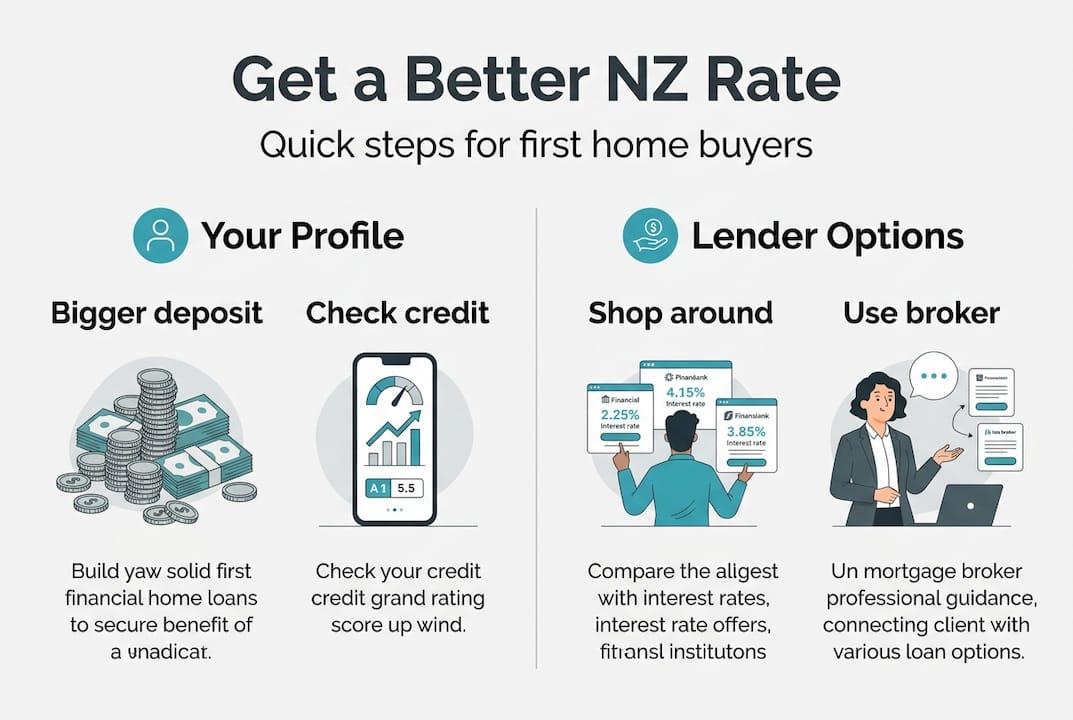
- Compare at least three lenders. Never stop at your own bank. Get 3+ quotes and use competitor offers as direct leverage. Some banks offer cashback incentives worth 1% to 2% of your loan amount, which is $5,000 to $10,000 on a $500,000 loan.
- Request specials explicitly. Banks routinely hold back promotional rates that are not advertised on their websites. Ask specifically whether any special rates or packages are available for first home buyers.
- Use a mortgage broker. A broker compares the market for you, has access to exclusive lender specials, and negotiates on your behalf, usually at no cost to you.
- Read beyond the headline rate. Compare the full loan structure, including break fees, top-up flexibility, offset account availability, and whether the lender allows extra repayments on fixed loans. A slightly higher rate with full flexibility may save more over time.
- Choose the right term for your fixed rate. A one-year fixed rate may look attractive, but if rates rise steeply at refix, you could end up worse off. Think about your plans for the next two to three years.
When it comes to refinancing later, the same principles apply. Set a calendar reminder before your fixed term expires so you are not rolled onto a floating rate by default, which is almost always more expensive.
Pro tip: Have all your documents ready before approaching lenders. Banks and brokers can move quickly on time-limited specials, and delays in paperwork mean lost opportunities. A payslip, three months of bank statements, and your ID should always be on hand.
Being organised is your golden ticket to cheapest home loan rates because lenders reward buyers who are clearly prepared and low-risk.
Understanding the kāinga ora First Home loan and its impact on rates
For many first home buyers, special programmes can be a critical rate lever, and none is bigger in New Zealand than the First Home scheme offered through First Home scheme.
The First Home loan is a government-backed product that lets eligible buyers purchase with just a 5% deposit at standard bank rates. This is a significant advantage because normal low-deposit lending attracts a low-equity margin of up to 1.5%. Some participating lenders may add a small premium of 0.25% to 0.50%, but this is far below what you would pay through a standard low-deposit loan.
To qualify, your income must be below $95,000 if you are buying alone, or below $150,000 combined for couples. You must also be a New Zealand citizen or permanent resident, and the property must be your primary home, not an investment.
Here is how the key numbers compare:
| loan type | min deposit | low-equity premium | income cap |
|---|---|---|---|
| Standard low-deposit | 5% to 19% | Up to 1.50% | None |
| First Home loan | 5% | 0% to 0.50% | $95k / $150k |
| Standard 20% deposit | 20%+ | None | None |
Participating lenders include major banks such as:
- ANZ
- ASB
- BNZ
- Co-operative Bank
- First Credit Union
- SBS Bank
- TSB
- Unity
- Select
- ReserveBank
Westpac and KiwiBank are also key participants and worth approaching directly. Each lender sets its own rates within the scheme, so comparing between them still matters. The difference between the best and worst rate on offer within the scheme can be 0.50% to 1.00%, which adds up to thousands over a five-year fixed term.
If you are on a modest income and have saved a 5% deposit, this scheme can be genuinely life-changing for your rate outcome.
Common pitfalls that lead to higher interest rates (and how to avoid them)
Knowing the right actions is half the battle. These are the mistakes we see most often from first home buyers that result in paying more than they need to.
- Going straight to your own bank. Most buyers approach the bank they already use, assuming loyalty counts. It rarely does. Banks price based on risk, not relationship history. Shopping around is non-negotiable.
- Not using a mortgage broker. A good broker gives you access to lender specials you cannot get on your own. Fixed rates often beat floating, and brokers help you access competitive fixed deals across multiple lenders including those supporting the First Home loan scheme.
- Taking a floating rate by default. Many buyers assume floating rates are flexible and therefore better. In reality, floating rates are typically 1% to 2% higher than a good fixed rate. Unless your circumstances demand flexibility, a short-term fixed rate is usually the better financial decision.
- Not checking eligibility for the First Home loan. Many buyers are surprised to learn they qualify. Do not assume you are not eligible without actually checking.
- Not accounting for fees. A low headline rate with high establishment fees can cost more over three years than a slightly higher rate with zero fees. Always calculate the total cost, not just the rate.
“The difference between buyers who secure great rates and those who do not almost always comes down to preparation and asking the right questions.”
Exploring non-bank lending options through a broker can also open doors that you would not find walking into a high street branch.
A mortgage expert’s take: what most first home buyers get wrong about rates
Here is something we see again and again working with New Zealand first home buyers: people walk into their bank, receive a rate offer, and accept it without question. Banks are businesses. They are not motivated to give you the lowest possible rate unprompted. They rely on buyer inexperience and the assumption that navigating mortgage negotiations is too complicated.
But here is the uncomfortable truth. The negotiation is not complicated. The first offer is rarely the best one. Most lenders have discretion to move on rate, especially when presented with a competing offer.
Another thing buyers get wrong is focusing only on the interest rate number. A lower rate with restrictive break fees, no ability to make lump-sum repayments, and a poor refix process can cost you more over the life of the loan than a slightly higher rate with full flexibility.
We have also found that working with a broker is almost always cost-neutral to the buyer. The broker is paid by the lender. You get access to more products, more ways to lower rates, and someone in your corner for the whole process. That is a deal worth taking.
How mortgage managers can help you get your best rate
Applying these strategies alone is possible, but it is a lot easier with an expert alongside you.

At personal shopper advisers at work, that is exactly what we do. We compare lenders, negotiate on your behalf, identify your eligibility for special programmes like the First Home loan, and make sure you are not leaving money on the table. Our team is based in Auckland’s Latest home loan rates page is also regularly updated so you can track what competitive looks like right now. We offer a free initial consultation, and we guide you from that very first conversation all the way through to settlement and beyond. Get in touch today and let us help you secure the best possible rate for your first home.
frequently asked questions
How much can shopping around actually lower your interest rate?
Comparing offers and negotiating can cut your rate by 0.25% or more. Based on 3+ lender quotes and using competitor offers as leverage, buyers can also secure cashback deals worth up to 1% to 2% of the loan amount.
Does getting pre-approved help you negotiate a better rate?
Yes. A pre-approval shows lenders you are serious and financially ready, allowing you to negotiate with real intent and access time-limited special offers before they expire.
What is the main advantage of the kāinga ora First Home loan for interest rates?
You can buy with just a 5% deposit and access standard bank rates, avoiding the high low-equity margin of standard low-deposit loans, though some lenders may add a small 0.25% to 0.50% premium.
Should first home buyers choose fixed or floating rates?
Fixed rates are generally lower and give you certainty over your repayments, while floating rates offer more flexibility if you need to make large extra payments or want to refinance without break fees.
Do brokers really get better rates for first home buyers?
Yes. Access to specials that are unavailable to the general public, combined with negotiation expertise, means brokers frequently secure better outcomes, usually with no cost to the buyer at all.