
Saving a 20% deposit feels like an impossible mountain to climb for many first home buyers in New Zealand. What if you could enter the market sooner with a smaller deposit? Lenders Mortgage Insurance makes this possible by protecting lenders when deposits fall below 20%, opening doors that many believe are firmly closed. This article explains what LMI is, how it affects your borrowing power, what it costs, and whether paying LMI premiums makes financial sense for your situation.
Table of Contents
- Key takeaways
- What is Lenders Mortgage Insurance and why does it matter?
- How LMI costs affect first home buyers with low deposits
- Benefits and trade-offs of LMI for first home buyers
- Navigating the LMI process and options in New Zealand lending
- Explore expert help with mortgages and LMI
- Frequently asked questions
Key Takeaways
| Point | Details |
|---|---|
| LMI protects lenders | Lenders Mortgage Insurance shields lenders when borrowers have deposits below twenty per cent, enabling loans that would otherwise be declined. |
| Cost varies by LVR | Premiums depend on loan size, deposit and lending product, typically 0.25 per cent to 1.5 per cent per year, or about two per cent as a one off. |
| First Home Loan levy | The Kāinga Ora First Home Loan imposes a 1.2 per cent one off levy for buyers with five per cent deposits, which can be capitalised into the loan. |
| Payment options explained | You can choose ongoing premiums added to your interest or a one off premium capitalised into the loan. |
What is Lenders Mortgage Insurance and why does it matter?
Lenders Mortgage Insurance protects lenders from losses if borrowers with low deposits default and the property sells for less than the outstanding loan balance. Banks and lenders face higher risk when lending to buyers without substantial equity buffers. LMI transfers this risk to insurance providers, making lenders more comfortable approving loans with smaller deposits.
You might also hear LMI called Low Equity Premium or LEP in New Zealand. Regardless of the name, the function remains identical. The insurance protects the financial institution, not you as the borrower. If you default on your loan, the insurer compensates the lender for their loss, but you still owe the full debt amount.
Lenders typically require LMI when your Loan-to-Value Ratio exceeds 80%. This means borrowing more than 80% of the property’s value, or conversely, having less than a 20% deposit. Understanding mortgage insurance in New Zealand helps you navigate this requirement strategically.
Key situations triggering LMI include:
- Purchasing property with deposits between 5% and 20%
- Refinancing when your equity sits below 20%
- Accessing equity for renovations or investments with high LVR
- First Home Loan schemes with government backing at 5% deposits
Pro Tip: LMI enables lenders to approve loans they would otherwise decline, effectively expanding your borrowing options when savings fall short of traditional deposit requirements.
The insurance premium gets calculated based on your loan amount, deposit size, and lending scheme. Banks incorporate LMI into their risk assessment frameworks, allowing them to maintain lending standards while serving buyers with limited savings. This mechanism has opened home ownership pathways for thousands of New Zealanders who would otherwise spend years accumulating larger deposits.
Without LMI, most lenders would simply refuse loans exceeding 80% LVR. The insurance creates a safety net that benefits both parties. Lenders can confidently approve higher-risk loans, while you gain market access despite limited savings. This risk-sharing arrangement fundamentally shapes New Zealand’s home loan landscape for first home buyers.
How LMI costs affect first home buyers with low deposits
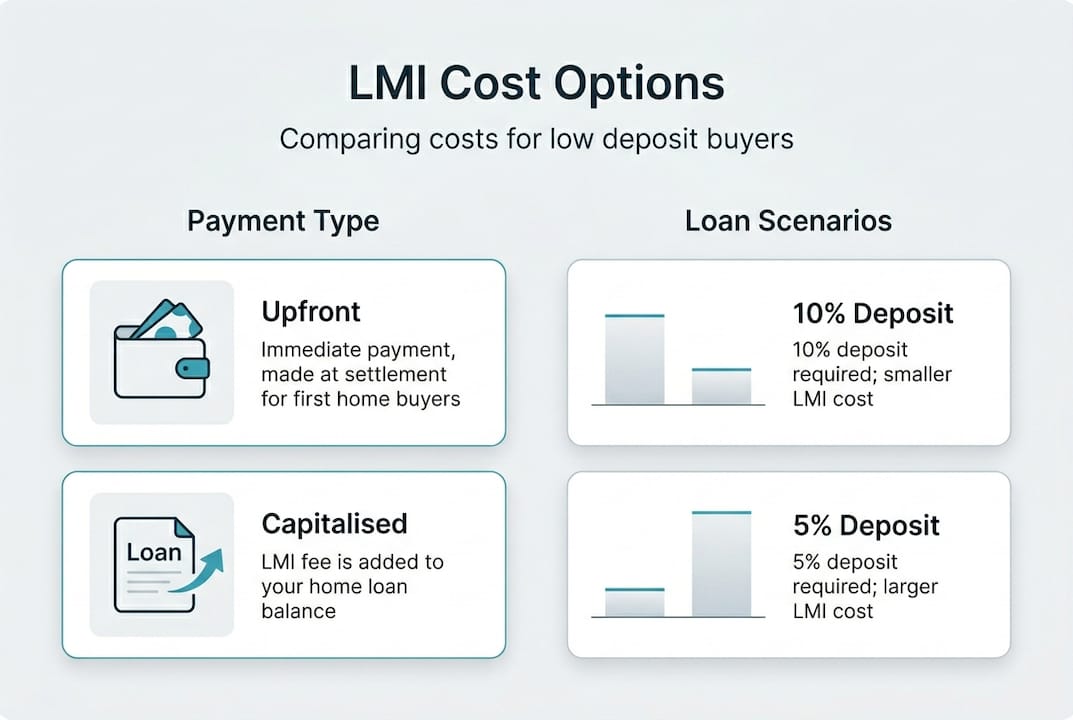
LMI costs vary significantly based on your Loan-to-Value Ratio and chosen lending product. Premiums range from 0.25% to 1.5% per annum as extra interest, or approximately 2% as a one-off premium. On a $500,000 loan, expect costs between $1,250 and $10,000 depending on structure and LVR.

The Kāinga Ora First Home Loan scheme applies a specific 1.2% one-off levy for buyers with 5% deposits. This translates to $6,000 on a $500,000 loan. Unlike ongoing premium structures, this one-time fee can be capitalised into your loan principal, spreading the cost across your mortgage term rather than requiring upfront payment.
| Loan amount | 10% deposit LMI | 5% deposit LMI (First Home) | Annual cost (0.5% p.a.) |
|---|---|---|---|
| $400,000 | $4,000-$6,000 | $4,800 | $2,000 |
| $500,000 | $5,000-$7,500 | $6,000 | $2,500 |
| $600,000 | $6,000-$9,000 | $7,200 | $3,000 |
| $700,000 | $7,000-$10,500 | $8,400 | $3,500 |
Payment structures fall into two main categories. Ongoing premiums add to your interest rate, increasing monthly repayments throughout the high-LVR period. One-off premiums require either upfront payment or capitalisation into the loan. Capitalising increases your principal, raising total interest paid over the loan term but preserving immediate cash flow.
Understanding low deposit mortgage options helps you compare total costs across different LMI structures. A $6,000 capitalised premium on a 30-year loan at 6.5% interest adds approximately $13,000 in total repayments when you factor in compound interest on the increased principal.
Pro Tip: Calculate whether entering the market sooner with LMI costs less than continuing to rent while saving a larger deposit, factoring in potential property appreciation and rent payments over the additional saving period.
Lenders assess LMI requirements during initial loan evaluation. Your mortgage adviser will outline specific costs based on your deposit size and chosen lending product. Some lenders offer multiple LMI structures, allowing you to select between ongoing premiums or capitalised one-off fees based on your financial priorities.
The First Home Loan capitalisation option particularly benefits buyers with limited cash reserves. Rather than finding an additional $6,000 upfront alongside deposit and settlement costs, you absorb this into your mortgage. Monthly repayments increase marginally, but you preserve savings for furniture, renovations, or emergency funds. Preparing for your home loan includes budgeting for these additional LMI-related costs.
Benefits and trade-offs of LMI for first home buyers
LMI fundamentally changes the timeline for home ownership. First home buyers enter the market sooner with smaller deposits, building equity earlier and potentially benefiting from property appreciation that offsets LMI costs. Instead of renting for three more years while saving an additional $50,000 for a 20% deposit, you could own property today and start building wealth.
Key benefits include:
- Market entry with deposits as low as 5% through First Home Loan schemes
- Immediate equity building rather than paying rent with zero ownership return
- Potential property appreciation offsetting LMI premium costs
- Faster pathway to renovations, upgrades, or investment properties
- Psychological benefits of home ownership and stability
Consider a scenario where property values increase 5% annually. Waiting three years to save a larger deposit means purchasing a $500,000 property that now costs $579,000. Your additional $50,000 in savings barely covers the price increase. Meanwhile, paying $6,000 in LMI today locks in current pricing and captures $79,000 in appreciation.
| Scenario | Deposit | LMI cost | Property price | Equity after 3 years |
|---|---|---|---|---|
| Wait and save | $100,000 (20%) | $0 | $579,000 | $100,000 |
| Buy now with LMI | $25,000 (5%) | $6,000 | $500,000 | $104,000 |
Trade-offs require careful consideration:
- Higher total loan costs due to LMI premiums and interest on larger principals
- Reduced equity buffer if property values decline shortly after purchase
- Potential mortgage stress if interest rates rise with minimal equity cushion
- Limited refinancing options until equity increases above 20%
- Ongoing premiums affecting monthly cash flow and savings capacity
Rent versus LMI calculations prove revealing. Paying $2,500 monthly rent equals $90,000 over three years with zero ownership benefit. A $6,000 LMI premium seems modest by comparison, especially when combined with equity building through mortgage repayments. Understanding LVR impacts helps you evaluate whether your specific situation favours immediate purchase or continued saving.
Pro Tip: Run detailed scenarios comparing total costs of waiting versus buying now with LMI, factoring in realistic property appreciation rates, current rent, and potential interest rate changes over your saving period.
Market conditions heavily influence whether LMI makes financial sense. Rising markets favour earlier entry despite premiums. Stable or declining markets reduce urgency, potentially making additional saving worthwhile. Your personal circumstances matter equally. Job security, income growth prospects, and family planning all affect whether taking on higher debt loads with LMI aligns with your broader financial goals. Getting a mortgage in New Zealand requires balancing these competing factors.
Navigating the LMI process and options in New Zealand lending
The mortgage application process incorporates LMI assessment automatically when your deposit falls below 20%. Lenders evaluate your income, expenses, credit history, and deposit source before determining loan approval and LMI requirements. Your application triggers insurance provider assessment, who calculate premiums based on risk factors including LVR, property type, and borrower profile.
Application steps involving LMI:
- Submit mortgage application with deposit documentation
- Lender assesses serviceability and approves conditional loan
- LMI provider evaluates risk and sets premium structure
- Choose between capitalising premium or paying upfront
- Finalise loan terms incorporating LMI costs
- Proceed to settlement with adjusted loan amount if capitalised
Capitalising LMI into your loan principal offers significant cash flow advantages. Kāinga Ora loans allow capitalisation of the 1.2% levy, meaning a $500,000 loan becomes $506,000 with the premium included. Your monthly repayments increase marginally, but you preserve savings for immediate post-purchase expenses like rates, insurance, and maintenance.
Questions to ask your mortgage adviser about LMI:
- Which lenders offer the most competitive LMI structures for my deposit size?
- Should I capitalise the premium or pay upfront based on my cash position?
- How does LMI affect my borrowing capacity and maximum loan amount?
- What happens to LMI costs if I refinance or sell within two years?
- Are there alternative lending products that reduce or eliminate LMI requirements?
- How quickly can I refinance to remove LMI once equity exceeds 20%?
Working with experienced mortgage advisers streamlines LMI navigation significantly. Brokers understand which lenders offer favourable LMI terms for specific borrower profiles. They negotiate on your behalf, potentially securing reduced premiums or more flexible capitalisation options. Their lender relationships and market knowledge prove invaluable when comparing total costs across multiple LMI structures.
Pro Tip: Engage a mortgage adviser early in your home buying journey to understand LMI implications before making offers, ensuring you budget accurately for all costs including premiums, legal fees, and deposit requirements.
The complete mortgage process typically takes four to six weeks from application to settlement. LMI assessment adds minimal time since insurers work directly with lenders during conditional approval stages. Once approved, your loan offer clearly outlines LMI costs, payment structure, and total borrowing amount.
Some lenders waive LMI for specific professions or through special schemes. Medical professionals, lawyers, and accountants occasionally access low-deposit lending without standard LMI requirements. First Home Loan schemes through Kāinga Ora apply fixed LMI levies rather than variable premiums. Exploring all available options with professional guidance ensures you secure the most cost-effective lending structure for your circumstances. Understanding mortgage insurance thoroughly positions you to make informed decisions.
Explore expert help with mortgages and LMI
Navigating LMI requirements and comparing lending options becomes significantly easier with professional mortgage advice. Expert advisers help first home buyers understand premium structures, evaluate whether LMI costs make financial sense for specific situations, and identify lenders offering the most competitive terms. They handle complex calculations comparing wait-and-save scenarios against immediate purchase with LMI, providing clarity when emotions run high during property searches.

Mortgage brokers access multiple lenders simultaneously, comparing LMI costs across different institutions to find optimal solutions. Their expertise proves particularly valuable for buyers using First Home Loan schemes or navigating complex income situations. Professional guidance transforms confusing premium structures and lending criteria into clear action plans. Speaking with Auckland mortgage brokers who understand local market conditions helps you make confident decisions about LMI and home ownership timing. Expert mortgage advisers provide personalised strategies aligned with your financial goals.
Frequently asked questions
What is Lenders Mortgage Insurance?
Lenders Mortgage Insurance is insurance protecting lenders from financial losses if borrowers with deposits below 20% default on their loans and property sales don’t cover outstanding balances. The insurance allows lenders to approve higher-risk loans they would otherwise decline. LMI protects the financial institution, not you as the borrower, meaning you remain liable for the full debt even if the insurer compensates the lender.
Do all first home buyers in New Zealand need to pay LMI?
LMI applies when your deposit falls below 20% of the property value, creating a Loan-to-Value Ratio above 80%. Buyers with 20% or larger deposits typically avoid LMI requirements entirely. Kāinga Ora First Home Loan schemes apply a specific 1.2% one-off levy that can be capitalised into your loan, making it accessible even with 5% deposits.
Can LMI be included in my mortgage loan?
Yes, many lenders allow you to capitalise LMI premiums into your loan principal rather than paying upfront. This increases your total loan amount and monthly repayments but preserves immediate cash for other settlement costs. Capitalising spreads the LMI cost across your entire mortgage term, with the trade-off being additional interest paid on the increased principal over time.
How does LMI benefit first home buyers?
LMI enables market entry with deposits as low as 5%, allowing you to start building equity years earlier than waiting to save 20%. Earlier purchase captures potential property appreciation and eliminates rent payments that provide zero ownership benefit. The insurance expands your borrowing options by making lenders comfortable approving loans they would otherwise refuse due to low equity positions.