
TL;DR:
- Debt servicing involves timely payments of all debts including mortgage principal and interest.
- Lenders assess your debt servicing ratio to determine borrowing capacity, stressing applications at higher interest rates.
- Improving your debt position by reducing debts and stabilizing income enhances mortgage approval chances.
Making your monthly mortgage payment on time feels like a win, and it absolutely is. But many New Zealand homeowners and first-time buyers are surprised to discover that keeping up with repayments is only one piece of a much bigger picture. Debt servicing is the act of making all scheduled payments to repay your debts, covering both principal and interest, so you consistently meet your obligations over the life of your loan. Understanding what that really means, how lenders measure it, and how to strengthen your position can be the difference between securing your dream home and being turned away at the door.
Table of Contents
- What debt servicing means in New Zealand
- How debt servicing ratios work and why they matter
- What Kiwi homeowners get wrong about serviceability
- How to optimise your debt servicing and boost home loan approval odds
- Why strict debt servicing assessments can actually help Kiwi buyers
- How expert support can make debt servicing easier
- Frequently asked questions
Key Takeaways
| Point | Details |
|---|---|
| Debt servicing definition | Debt servicing means making all required repayments on debts like your mortgage, not just your monthly instalment. |
| Debt servicing ratio (DSR) | Lenders use DSR to assess if your income can cover all debt repayments when reviewing applications. |
| Serviceability pitfalls | Ignoring stress tests and other debt obligations can lead to failed mortgage applications even if current repayments seem affordable. |
| Practical improvement steps | Reducing other debts and checking your finances with reliable calculators can strengthen your loan eligibility. |
| Expert guidance matters | Mortgage advisers can help you optimise your debt servicing and improve your chances of home loan approval. |
What debt servicing means in New Zealand
Let’s begin by clarifying the meaning of debt servicing as it’s used in New Zealand, using daily mortgage examples.
At its core, debt servicing means meeting all your required repayments, on time and in full. For most Kiwi homeowners, the biggest debt to service is their mortgage. Your repayments cover two components: the principal (the amount you originally borrowed) and the interest (the cost of borrowing that money). These two components don’t always split evenly throughout your loan term.
In the early years of a home loan, mortgage repayments are interest-heavy, meaning the bulk of what you pay goes toward interest rather than reducing your actual loan balance. As time passes and your loan balance shrinks, more of each payment chips away at the principal. This is called amortisation, and it’s why paying a little extra early in your mortgage can save you a surprising amount of interest over the long run.
Here’s a simplified look at how repayments might shift over a 30-year mortgage:
| Loan year | Monthly repayment | Interest portion | Principal portion |
|---|---|---|---|
| Year 1 | $2,200 | $1,750 | $450 |
| Year 10 | $2,200 | $1,350 | $850 |
| Year 20 | $2,200 | $800 | $1,400 |
| Year 30 | $2,200 | $150 | $2,050 |
Example figures only, based on a $500,000 loan at approximately 6.5% interest.
Understanding this breakdown matters because it affects how you plan your finances and how lenders view your mortgage servicing for first-home buyers. Missing payments, even occasionally, can damage your credit profile and limit your future borrowing options. Underestimating your ongoing costs, such as rates, insurance, and maintenance, can stretch your budget thin and make debt servicing harder than expected.
Key responsibilities of debt servicing for NZ homeowners include:
- Making repayments on time every week, fortnight, or month
- Accounting for all debts, not just your mortgage
- Planning for interest rate changes that could increase your repayments
- Keeping a buffer so unexpected expenses don’t derail your payments
You can use a mortgage payment breakdown tool to see exactly how your repayments are structured over time. Seeing those numbers laid out clearly can be genuinely eye-opening.
How debt servicing ratios work and why they matter
Now that you know what debt servicing is, it’s crucial to understand how lenders measure it with ratios and why those ratios influence your home loan opportunities.

The debt servicing ratio (DSR) is the key metric lenders use to assess whether you can afford to take on a mortgage or additional borrowing. The formula is straightforward: divide your total annual debt repayments by your annual net income. The result tells lenders how much of your income is already committed to debt.
Here’s how to calculate it step by step:
- Add up all your annual debt repayments (mortgage, car loan, credit card minimums, personal loans).
- Calculate your annual net income (after tax, including any regular secondary income).
- Divide total repayments by net income.
- Compare the result to lender benchmarks.
A DSR below 1.0 means your income is less than what’s needed to cover your debts, which is a serious red flag for any lender. Most banks want to see a comfortable margin above 1, meaning your income clearly exceeds your debt obligations. The higher your DSR above 1, the more borrowing capacity you generally have.
“A ratio below 1.0 means less income than needed to service debts, potentially impacting additional lending capability.” This is why your DSR is one of the first things a lender checks when you apply for a home loan.
Here’s a comparison of how different DSR levels are typically interpreted:
| DSR result | What it means | Likely lender response |
|---|---|---|
| Below 1.0 | Income insufficient to cover debts | Loan likely declined |
| 1.0 to 1.2 | Very tight margin | May require further justification |
| 1.2 to 1.5 | Acceptable but limited | Conditional approval possible |
| Above 1.5 | Strong servicing capacity | Favourable lending conditions |
Lenders don’t just use your current interest rate when running these numbers. They often stress-test your application using a higher rate, sometimes 2% to 3% above the current rate, to ensure you could still service the loan if rates rise. This is a safeguard, not a punishment. It’s designed to protect you just as much as the bank.
Pro Tip: Before you apply, use a loan payment calculator to run your own numbers at a rate 2% higher than what you’re currently quoted. If the repayments still feel manageable, you’re in a solid position. If they don’t, it’s time to reassess your borrowing amount.
Understanding the mortgage approval process in NZ means knowing that your DSR is one of several factors assessed, alongside your deposit, credit history, and employment stability. And if you’re unsure how your repayments are calculating mortgage repayments in the first place, getting clarity on that number is a smart first move.
What Kiwi homeowners get wrong about serviceability
With the basics and key ratios explained, it’s important to tackle some common traps and misunderstandings that catch buyers and owners out.
One of the biggest misconceptions is this: “I can afford my repayments now, so I should be able to borrow more.” It sounds logical, but it’s not how lenders think. Your serviceability assessment goes well beyond what you’re currently paying. Lenders look at your total debt picture, stress-test your capacity at higher rates, and factor in expenses you might not have considered.
Here are some of the most common mistakes New Zealand homeowners and first-time buyers make:
- Ignoring other debts: Your car loan, credit card limits (not just balances), student loans, and buy-now-pay-later accounts all count against your serviceability. Even a credit card you rarely use can reduce your borrowing power significantly.
- Assuming income alone is enough: A strong salary is helpful, but lenders also scrutinise your spending habits, existing liabilities, and whether your income is stable or variable.
- Not knowing about stress-testing: Many buyers are genuinely surprised to learn that lenders test their application at a higher interest rate than the one they’ll actually pay. This is standard practice across New Zealand banks.
- Making only minimum repayments: If you’re only paying the minimum on credit cards and personal loans, those balances linger and drag down your DSR for longer.
“Your required ‘serviceability’ may differ from simply looking at monthly repayments; lenders may stress-test rates and include other debt in affordability.” This is the reality many buyers only discover during the application process.
New Zealand’s regulatory environment adds another layer. Lending rules in NZ are tied to debt-to-income (DTI) ratio limits, which cap how much you can borrow relative to your income. Even if your repayments are comfortably affordable, you might hit a regulatory ceiling that prevents you from borrowing as much as you’d hoped.
Pro Tip: Check your credit report before applying for a mortgage. Errors or forgotten debts can quietly undermine your serviceability. Fixing these issues in advance can meaningfully improve your position.
If you’re carrying multiple debts and finding it hard to get a clear picture, exploring debt consolidation strategies might be worth your time. Consolidating smaller debts into one manageable repayment can simplify your finances and potentially improve your DSR. You can also model the impact of extra mortgage payments to see how paying more now reduces your long-term interest bill.
How to optimise your debt servicing and boost home loan approval odds
Armed with what to avoid, let’s finish with proven strategies for putting yourself in the best possible loan-servicing position.
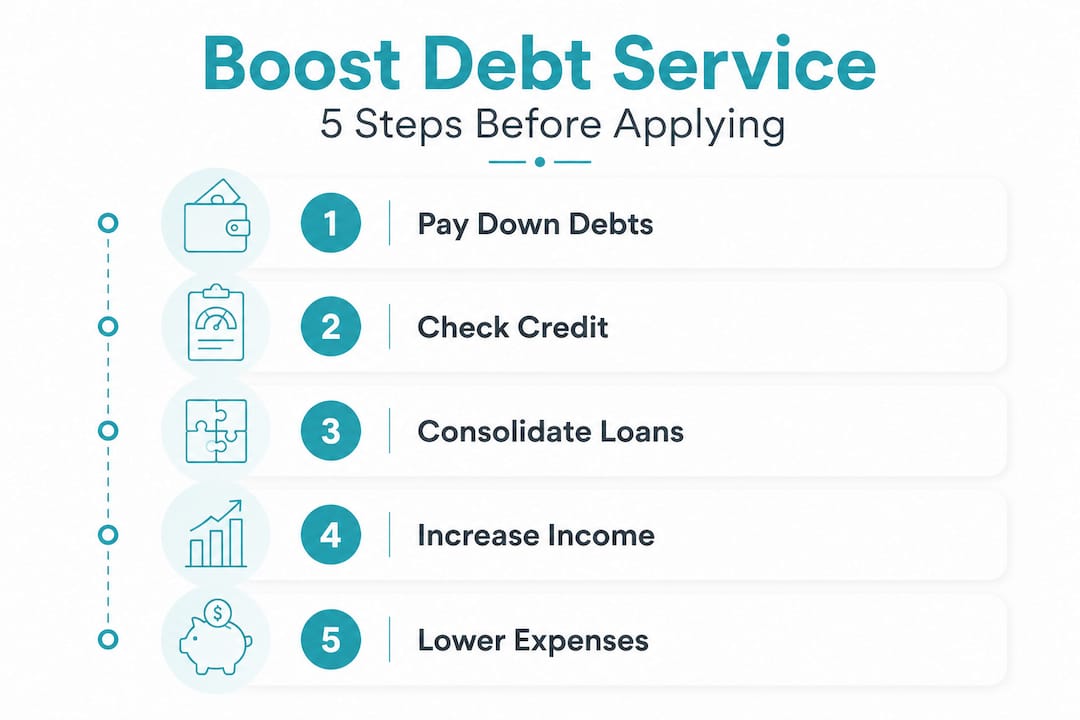
Improving your debt servicing position isn’t about overnight miracles. It’s about making deliberate, consistent choices that lenders will notice and reward. Here’s a practical roadmap:
- Pay down high-interest debts first. Car loans, personal loans, and credit card balances all count against your DSR. Eliminating or reducing these frees up more of your income for mortgage servicing.
- Close credit facilities you don’t use. Lenders count available credit limits, not just balances. An unused $10,000 credit card limit can reduce your borrowing power even if the balance is zero.
- Add a co-borrower if possible. Including a partner or family member with stable income can significantly strengthen your application by increasing the income side of the DSR equation.
- Avoid new credit applications. Every credit enquiry leaves a mark on your credit file. Multiple enquiries in a short period signal financial stress to lenders, even if you’re just shopping around.
- Stabilise your income. Lenders prefer consistent, predictable income. If you’re self-employed or rely on commissions, having two or more years of documented income history makes a big difference.
- Consider debt consolidation. Rolling multiple debts into one lower-rate facility can reduce your total monthly obligations and improve your DSR. Speak with an adviser before doing this, as it needs to be structured correctly.
Because DTI lending rules are woven into how New Zealand banks assess applications, your strategy needs to account for both your DSR and your total debt-to-income position. These two measures work together, and improving one often improves the other.
Additional steps worth taking:
- Review your budget and identify any recurring expenses that could be reduced
- Build a genuine savings buffer to demonstrate financial discipline to lenders
- Seek pre-approval before house hunting so you know exactly where you stand
- Work with an adviser to identify which lender’s criteria best suits your situation
Pro Tip: Start improving your debt servicing position at least six months before you plan to apply for a mortgage. Lenders often look at your financial behaviour over the preceding three to six months, so the sooner you start, the better your application will look. Explore options for boosting home loan eligibility to get a head start.
Why strict debt servicing assessments can actually help Kiwi buyers
Finally, it’s worth sharing an industry perspective on why seemingly rigid lending rules can benefit homeowners more than they realise.
We hear it regularly from clients: the serviceability rules feel frustrating, even unfair. You’ve saved hard, you earn a decent income, and yet the bank still wants to stress-test your application at a rate you may never actually pay. It can feel like the system is working against you. But from where we sit, having worked with hundreds of New Zealand buyers across Auckland and beyond, these rules often turn out to be one of the most valuable protections a borrower has.
Think of the stress test as a financial seatbelt. You hope you never need it, but you’re deeply grateful it’s there when circumstances change. And circumstances do change. Interest rates shifted significantly in New Zealand between 2021 and 2024, and many homeowners who borrowed at the top of their capacity found themselves under real pressure when rates rose. Those who had been assessed at a higher stress-test rate had a built-in buffer that gave them breathing room.
The same logic applies to life events. A job loss, a health issue, a new baby, or a relationship change can all affect your ability to service debt. Lenders who require you to demonstrate capacity beyond your current repayments are, in a very real sense, protecting your future self from your present optimism.
We’ve also seen the other side. Buyers who stretched to the absolute limit of what they could borrow, sometimes by working around serviceability requirements, often found themselves in a precarious position within a few years. The short-term win of getting the bigger loan came at the cost of long-term financial security.
The first home buyer strategies that tend to work best are the ones built on honest financial assessment, not wishful thinking. When you understand your true servicing capacity and work within it, you build a foundation that can weather whatever the market throws at you.
How expert support can make debt servicing easier
Ready for practical help? Here’s how an expert adviser can support your home buying journey or ongoing home loan management.
Navigating debt servicing rules, DSR calculations, and lender criteria on your own can feel like trying to read a map in the dark. That’s where we come in. At Mortgage Managers, we specialise in helping New Zealand homeowners and first-time buyers understand exactly where they stand and what steps to take next.

Our advisers know the serviceability requirements of different lenders inside and out. We can assess your current DSR, identify areas for improvement, and match you with the right loan product for your situation. Whether you need personalised mortgage advice before your first application or guidance on restructuring existing debt, we’re here to make the process clearer and less stressful. Visit Mortgage Managers to connect with our team and take the next step toward confident homeownership.
Frequently asked questions
What is included in debt servicing for NZ homeowners?
Debt servicing includes all regular repayments for mortgages, personal loans, credit cards and any debts you’re obligated to pay, covering both principal and interest components.
How do banks calculate my debt servicing ability?
Banks calculate the debt servicing ratio by dividing your total required annual repayments by your net income, and often stress-test the result using a higher interest rate than you’ll actually pay.
What happens if my debt servicing ratio is too low?
If your ratio falls below 1.0, lenders consider your income insufficient to cover your debts, which typically means your mortgage application will be declined or significantly limited.
Do lenders look at all my debts or just my mortgage repayments?
Lenders assess your full financial picture, and serviceability assessments include mortgages, credit card limits, car loans and personal loans, not just your home loan repayments.
What can I do to improve my debt servicing position before applying for a mortgage?
Reduce existing debts, avoid new credit applications, increase your income where possible, and consider debt consolidation, as DTI lending rules mean your total debt load directly affects how much you can borrow.